8 Week Mass Building Workout for Beginners

Many people who find their way to Muscle & Strength are looking to build just that – muscle and strength. Whether it’s a teenager just starting in the gym or a college student trying to impress others, size is the prize, and they want to do whatever it takes to get it.
Good news: we have a plan that will help you stretch sleeves, build mass, and bump up that number on the scale. If you can commit eight weeks to this as if your future depends on it, then you can kickstart your journey to getting swole.

FAQ’s
Can I change the exercises or the order?
If you need to replace an exercise because you don’t have the equipment or tools to perform it, then you can change the exercise to a similar one. For example, you can replace a press with a press or a squat with another squat. Don’t change an exercise for another because one is easier than the other. If you want to grow, you’ll have to work. Taking shortcuts helps no one, and we want to help you.
Related: Lower Body Alternatives to Your Favorite Gym Machines
As for the order, if your gym is set up so that it would be easier for you to train consistently, go for it. However, these movements are in place so you can train everything from as many angles as possible. Each movement should support the one before it. This plan doesn’t do that 100 percent, but it will serve you very well if you follow it as recommended.
Related: Upper Body Alternatives to Your Favorite Gym Machines
Can I use this for fat loss?
This particular program is meant for those who are either new to training or have a strong desire to get bigger and stronger. You would have to alter your cardio, nutrition, and training to convert this to a fat-loss program. If fat loss is your goal, then you can check out many of our other awesome programs here at M&S.
Related: 12 Week Fat Destroyer: Complete Fat Loss Workout & Diet Program
So, I can eat whatever I want, right?
No. If you want to build quality mass and muscle, then you need to support those muscles with quality calories. I’m not saying you can’t treat yourself once or even twice a week, but overall, you should eat big (and healthy) to get big (and healthy).
Related: How To Plan Your Muscle Building Diet
How much size will I put on?
That is up to you and how hard you work. There is no specific way to guarantee the set number of pounds or kilograms you will gain on any program. Your training effort, experience, recovery, food, and supplements (if you take any) will all be factors in that. Some of you may gain five pounds while others will gain 15.
Related: How to Build Muscle: 5 Step Guide to Lean Gains
This is simple. How can I make it harder?
This plan is meant for beginners, and we want to keep it simple for them to start. If you need intensity boosters, more advanced exercises, and other ways to challenge yourself, we have other options for you to take on.
Find Your Nutrition Numbers
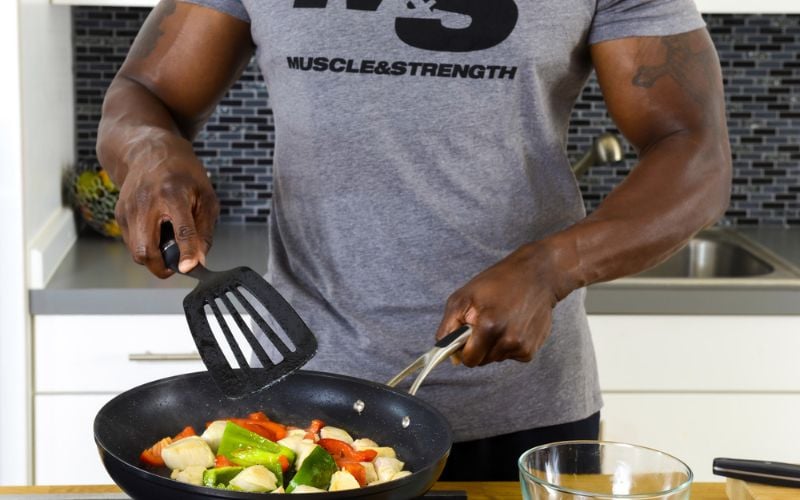
Speaking of eating, let’s talk about nutrition. We don’t have too many specific diets because there is such a wide array of healthy foods, and the M&S community consists of many people from many cultures. What we do offer is guidance to help you determine your diet, and that is what we’re doing here.
During my time as a personal trainer, I worked with many people who wanted to grow for sports or simply for self-confidence. I recommended the same formula that helped me when I was a 125-pound senior in high school starting on my fitness journey.
Related: How To Determine Your Daily Calorie And Macronutrient Intake Levels
I set daily goals of eating 1 gram of protein, 2 grams of carbohydrates, and .5 grams of fats per pound of body weight. I then took all those numbers and divided them by 6. That determined how much I was to eat per meal. So, using my beginner self as an example, I needed to have 125 grams of protein, 250 grams of carbs, and 65 grams of fat (I rounded up).
Per meal, that looked like this:
- 20-25 grams of protein
- 40-50 grams of carbs
- 10-12 grams of fats
Why six meals? There have been a lot of arguments over the years about whether three or six meals are best for muscle growth. I’m going to be completely honest, it was easier for me to eat the smaller meals, so that was what I did. There’s something to be said about finding the best way for you.
Then, there’s water. For people wanting to grow, I always suggested a gallon of water a day, and that was what I did myself. Eight glasses are considered the standard, but if you want to grow and are training hard, then you need extra hydration.
Related: How to Time Your Pre and Post Workout Nutrition Intake
Workout Overview
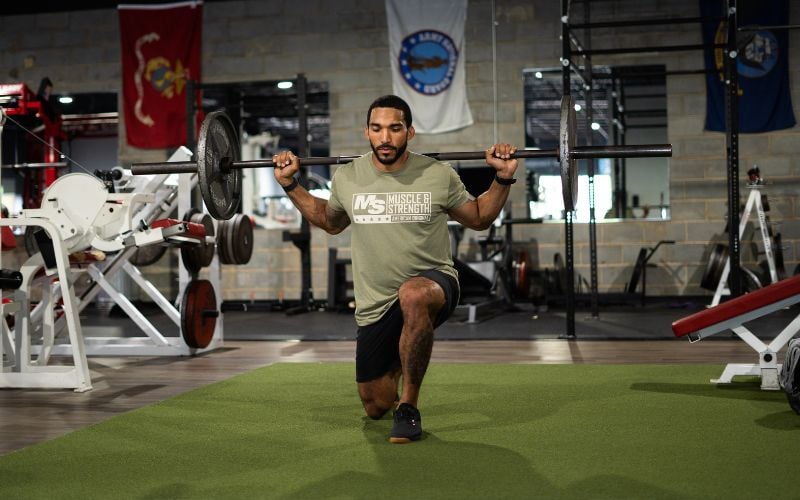
Every exercise in this program will call for four sets of 12, 10, 8, and 6 reps. This means you will gradually lift heavier weights for fewer reps, which should be a little more difficult. You won’t be able to go to failure on all four sets. You should only push yourself to the end of the six-rep set.
Many of you are familiar with Rate of Perceived Exertion (RPE), which is a gauge to determine how hard you’re working. You can use that formula to determine the weights you use. My suggested plan would look like this:
- Set 1 – 12 reps, RPE 7
- Set 2 – 10 reps, RPE 8
- Set 3 – 8 reps, RPE 9
- Set 4 – 6 reps, RPE 10
And if you're looking for a suggested training schedule here are a few examples below:
Example 1:
- Monday: Workout 1
- Tuesday: Workout 2
- Wednesday: Rest
- Thursday: Workout 3
- Friday: Workout 4
- Saturday: Rest
- Sunday: Rest
Example 2:
- Monday: Workout 1
- Tuesday: Workout 2
- Wednesday: Rest
- Thursday: Rest
- Friday: Workout 3
- Saturday: Workout 4
- Sunday: Rest
Example 3:
- Monday: Workout 1
- Tuesday: Rest
- Wednesday: Workout 2
- Thursday: Rest
- Friday: Workout 3
- Saturday: Rest
- Sunday: Workout 4
Remember, the best workout schedule is one you can follow.
8 Week Mass Building Workout for Beginners
Workout 1 – Chest/Shoulders
| Exercise | Sets | Reps |
|---|---|---|
| Incline Bench Press | 4 | 12, 10, 8, 6 |
| Dumbbell Bench Press | 4 | 12, 10, 8, 6 |
| Cable Crossover | 4 | 12, 10, 8, 6 |
| Tricep Dip | 4 | 12, 10, 8, 6 |
| Seated Dumbbell Press | 4 | 12, 10, 8, 6 |
| Lateral Raise | 4 | 12, 10, 8, 6 |
| Machine Reverse Fly | 4 | 12, 10, 8, 6 |
Workout 2 - Back
| Exercise | Sets | Reps |
|---|---|---|
| Deadlift | 4 | 12, 10, 8, 6 |
| One Arm Dumbbell Row | 4 | 12, 10, 8, 6 |
| Lat Pull Down | 4 | 12, 10, 8, 6 |
| Seated Row | 4 | 12, 10, 8, 6 |
| Single Arm Lat Pull Down | 4 | 12, 10, 8, 6 |
| Hyperextension | 4 | 12, 10, 8, 6 |
| Dumbbell Shrug | 4 | 12, 10, 8, 6 |
Workout 3 - Legs
| Exercise | Sets | Reps |
|---|---|---|
| Barbell Squat | 4 | 12, 10, 8, 6 |
| Hack Squat | 4 | 12, 10, 8, 6 |
| Leg Press | 4 | 12, 10, 8, 6 |
| Dumbbell Lunge | 4 | 12, 10, 8, 6 |
| Lying Leg Curl | 4 | 12, 10, 8, 6 |
| Seated Calf Raise | 4 | 12, 10, 8, 6 |
| Standing Calf Raise | 4 | 12, 10, 8, 6 |
Workout 4 - Arms
| Exercise | Sets | Reps |
|---|---|---|
| Close Grip Bench Press | 4 | 12, 10, 8, 6 |
| One-Arm Seated Overhead Tricep Extension | 4 | 12, 10, 8, 6 |
| Straight Bar Tricep Extension | 4 | 12, 10, 8, 6 |
| Barbell Preacher Curl | 4 | 12, 10, 8, 6 |
| Incline Dumbbell Curl | 4 | 12, 10, 8, 6 |
| Cable Curl | 4 | 12, 10, 8, 6 |
| Seated Barbell Wrist Curl | 4 | 12, 10, 8, 6 |
Cardio
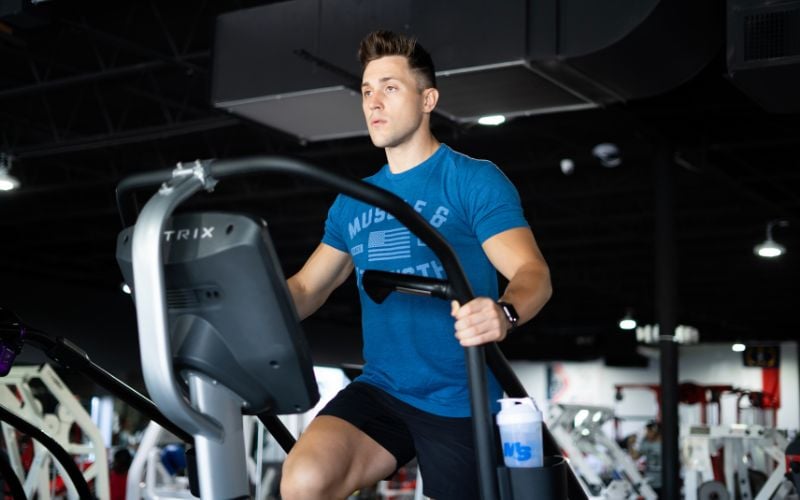
There is a misconception that you shouldn’t do cardio at all if you want to gain mass. This isn’t accurate. Cardio is very important for aerobic health, recovery, and overall wellness. You don’t have to go run marathons or spend an hour on a Stepmill, but you should be doing active walking or cardio three to four times a week.
Schedule 20 minutes either after a workout or away from training. You should feel like you put in effort, but don’t take it to an extreme. You just want to be moving, not torching every single calorie you put in your body.
Recovery
Even with all the work that is on the program, there is going to be a temptation to do more. I would suggest channeling that energy and enthusiasm towards your recovery instead. Get a massage, use a foam roller, or devote time to extra stretching. The mindset should be that you’re preparing for that next workout and want to be your best for it.
Beyond that, your calories and sleep are also going to help you maximize recovery. That is why even though you want to grow, you need to be eating quality calories and getting great sleep.
Conclusion
The method of building mass can be simple, but that doesn’t mean it’s easy. You’re going to work hard and will have to eat and recover smart to reach those goals. However, that doesn’t mean It’s impossible. It can be done, and yes, you can do it. If you have questions as you go through the process, hit us up in the Comments section, and we’ll do our best to help you along the way.