How To Determine Your Daily Calorie And Macronutrient Intake Levels

The goal of this article is to provide you with guidelines that will help you determine not only how much food to eat per day, but also how to portion your macronutrients (i.e. protein, carbohydrates, and fats).
We'll take a look at general terms and their definitions, along with formulas that can help you get on the right path. Before we dive in, I want to advise taking a week or two to study your current eating habits. Write down everything you eat, and find out how many calories, and grams of protein, carbs and fats you are eating each day. Be honest with yourself and track everything you eat, even that handful of chips you grab as you walk past the pantry.
This will take some work but you must do it. If you don't understand portions, calories and macronutrient compositions of the foods you are eating, the information in the rest of this article won't matter or help.
Calorie Expenditure - From BMR to TDEE
BMR
BMR, or basal metabolic rate, is essentially the number of calories you would require on a daily basis if you didn't move at all and expended a minimal amount of energy. To calculate your BMR, check out our BMR calculator.
BMR is commonly mistaken for the number of calories you should eat each day. This is not the case unless you are bedridden. It is a base level if you have zero activity on a daily basis, and nothing more.
NEAT
NEAT, or non-exercise activity thermogenesis (sometimes referred to as non-exercise associated thermogenesis), is the amount of calories you expend on a daily basis from non-planned movement or exercise. Non-activity calorie expenditure could include walking during work, talking, going to the store or doing household chores. Again, NEAT does NOT include planned gym cardio, conditioning, and weight training sessions.
You typically have control over the incidental expended calories that are excluded in NEAT. You can choose to not go to the store, or to not clean your house, etc.
EAT
EAT, or exercise associated thermogenesis, refers to daily expended calories that come from planned exercise sessions. So for EAT, incidental exercise, such as going to the store or walking during work, is not included. Only your cardio, resistance training, Zumba, p90x, etc. sessions are totaled.
TEF
TEF, or thermal effect of feeding, is the amount of energy burned directly related to food intake and digestion. TEF will vary based on a meal's fiber and macronutrient composition.
TEF is measured as a percentage of a meal's overall calories. A typical meal's TEF is around 15%. An all-protein meal might have a TEF as high as 25%, while the TEF of fat is typically below 5%. Carbs fall somewhere in the middle and can land anywhere between 5 to 25% TEF. Fiber also has a high TEF.
TDEE
TDEE, or total daily energy expenditure, is the combination of your BMR, NEAT, EAT and TEF. It is the complete amount of calories you burn on any given day.
TDEE = BMR + NEAT + EAT + TEF

Factors That Impact BMR and TDEE
Here are some of the major or important factors that impact your TDEE, or total daily energy expenditure.
- Testosterone Levels - Long term (as opposed to abrupt) decreasing changes in testosterone levels can lower your BMR.
- Sex - Men general have higher BMRs than women.
- Health - If you are sick or injured, you typically are not moving around as much.
- Puberty - If you are growing at a rapid pace then you are probably expending more energy than normal.
- Pregnancy - Pregnancy will increase your energy expenditure.
- Weight - The heavier you are, the more energy you will expend sustaining this weight.
- Muscle Tissue - Extra muscle tissue increases the amount of energy you expend on a daily basis.
- Job - Sedentary job or always on your feet?
- Exercise - Exercise impacts TDEE, obviously.
- Diet Composition - Diet composition impacts your TEF, which can increase or decrease daily expended energy.
- Non-Planned Exercise Activity - Are you a busy body or do you chill in front of the TV at night?
- Body Temperature - The higher your temp, the more energy you burn.
- Thyroid Hormone Levels - High levels increase BMR.
- Caffeine and Tobacco - Using these can increase your BMR.
- Climate - Working or sleeping in an environment that is a little hotter or cooler than normal will lead to greater energy expenditure.
- Stress - If you are stressed out you will typical see an increase in your energy expenditure.
Estimating Your BMR
Listed below are several methods used to determine daily calorie requirements.
Katch-McArdle BMR Formula
The Katch-McArdle method is considered a reliable method of estimating your daily BMR if you are fairly lean and have a reasonably accurate estimation of your body fat percentage. The equation is:
BMR = 370 + (21.6 x LBM)
LBM = lean body mass in kgs (not pounds), or total weight minus your fat weight.
Cunningham Formula For BMR
Another formula that hinges on having an accurate body fat percentage reading.
BMR = 500 + (22 x LBM)
LBM = lean body mass in kgs(not pounds), or total weight minus your fat weight.
Mifflin St Jeor BMR Equation
This equation was considered the best BMR calculator until around 1990 or so. It does not taken into consideration body composition.

"s" = +5 for men and -161 for women
"m" = weight in kilograms
"h" = height in centimeters
"a" = age in years
Original Harris-Benedict BMR Equation
The original Harris-Benedict equation was create in 1919. It contains 2 different formulas, one for men and one for women.
For men:

For women:

"m" = weight in kilograms
"h" = height in centimeters
"a" = age in years
Revised Harris-Benedict BMR Equation
In 1984 the Harris-Benedict equation was reworked to include modern data.
For men:

For women:

"m" = weight in kilograms
"h" = height in centimeters
"a" = age in years
Activity Levels - Calculating Your TDEE
Now that you have estimated your BMR, you will want to multiply it by one of the following factors based on your activity level. Our BMR calculator is a quick way to determine your caloric needs based on the activity rates below.
- Sedentary - BMR x 1.2: Don't get much exercise at work - desk job. You then come come at "veg" in front of the TV.
- Lightly Active - BMR x 1.375: Some daily activity, plus you exercise or perform a sport 1-3 days per week.
- Moderately Active - BMR x 1.55: A fair amount of daily activity, plus you exercise or perform a sport 3-5 days per week.
- Very Active - BMR x 1.725: Very active, and you exercise or play sports 6-7 days per week.
- Highly Active - BMR x 1.9: Extremely active, including up to twice a day training and/or a very physical job.
Understand that these numbers are designed to give you a rough estimation. The first 2 weeks at a new calorie level can result in abnormal weight gain or weight loss as your body accumulates or flushes water weight due to changing sodium and carb intake levels. Do not worry about weight gained or lost during the first 2 weeks of a cut or bulk unless it is unusual.
After this 2 week period you will want to monitor your weight and make slight adjustments based on goals.
Macronutrient Basics
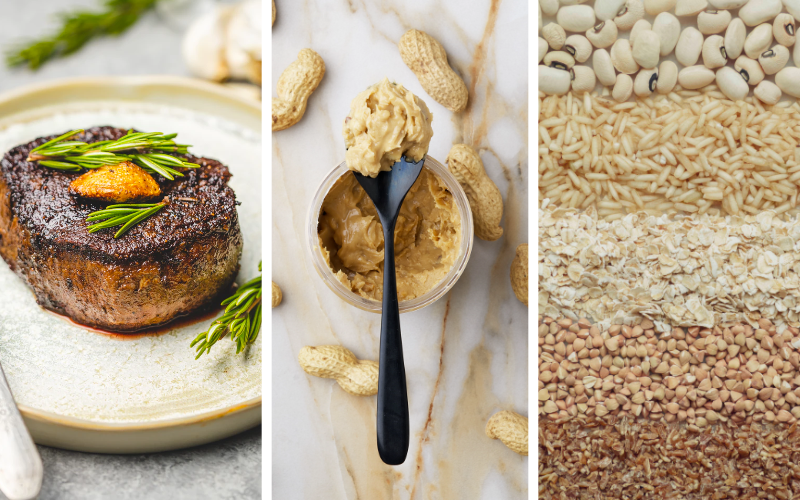
Now that you know how many calories you will be eating per day, it's time to determine the macronutrient makeup of your diet. Once again, macronutrients are: proteins, fats and carbs. Each have different caloric values.
- Protein - 4 calories per gram
- Fats - 9 calories per gram
- Carbs - 4 calories per gram
Protein Intake
Protein intake can be a controversial topic. Some folks claim you should never eat over 150 grams per day. While the effectiveness of eating over 150 grams per day for muscle building is debatable, there are certainly dietary reasons for eating more than 150 grams.
Extra protein intake is perfectly safe unless you have a pre-existing kidney function issue. If you are underweight, or on a bulk and building muscle at a rapid pace, then I recommend 200 to 250 grams of protein per day depending on your calorie requirements.
If you are eating a ton of calories per day, push your protein intake to around 250 grams. For example, if your calorie intake is around 3000, then 200-220 daily grams might be a good option. I will also add that if you have already built a quality amount of muscle mass or you are on a cutting diet, then it might be worth your time to eat a little more protein than normal.
For lifters who are gaining at a moderate pace and are on somewhat of a slow and clean bulk, then 180 to 220 grams of daily protein is a good choice. Again, align your intake based on you calories needs and or dietary preferences.
Women should consider eating 100-120 grams of protein per day. If you are a younger woman and/or highly active, eat 120 grams per day.
Fat Intake
Fat does not make you fat. For general health, your body needs a fat intake of 20-35% of your overall daily calorie needs.
If you feel you function better on high carbs, then reducing your fat intake to 20-25% of your calorie needs might be an option. If you have problems eating enough food, or you are carb-sensitive, then a higher fat content is recommended.
Related: Should You Eat a "Low Carb" or "High Carb" Diet?
Carb Intake
Now that you know your daily protein and fat intake levels, you can easily determine your carb requirements.
Keep in mind that you can adjust these numbers and levels as needed, based on what your body is telling you. I functioned better on higher carbs when I was younger and better on higher fats in my 40s.
Listening to your body is very important. Remember to make small, gradual changes so you can assess future needs more easily.
Calculating Your Macros
Keep in mind that the numbers below serve as a starting point, and you can alter them based on your goals, lifestyle, and body type.
Fat Loss Macro Ratios
- 40-50% protein
- 30-40% fats
- 10-30% carbs
Maintenance Macro Ratios
- 25-35% protein
- 25-35% fats
- 30-50% carbs
Muscle Gain Macro Ratios
- 25-35% protein
- 15-25% fat
- 30-40% carb
Let's look at an example. Trevor is a 28 year old male who is 6'2", weighs in at 175 pounds, and is moderately active (moderate exercise/sports 3-5 days/week). Using our BMR calculator, Trevor's daily calorie requirement comes in at 2,954 calories per day. He is looking to put on muscle mass so we will add 500 calories to his daily caloric requirement. That gives us 3,454 calories per day. His calcuated macros are as follows:
- Protein: 260 grams
3454 calories * 30% = 1036 calories
1036 calories / 4 calories per gram = 260 grams - Fat: 96 grams
3454 calories * 25% = 864 calories
864 calories / 9 calories per gram = 96 grams - Carbs: 389 grams
3454 calories * 45% = 1554 calories
1554 calories / 4 calories per gram = 389 grams