Jump Around: How You Can Benefit from Plyometrics

Here’s an honest truth: Your muscles and muscular development will serve very little purpose if you’re all “show” and no “go”.
What I mean is, many times we get stuck in the rabbit hole of training for aesthetics, and taking a meathead approach for our gains.
And hey, maybe that’s exactly what we’re after and nothing more, an impressive physique built in the gym. And that’s fine.
But it’s still worth the warning that carrying around an abundance of muscle just compounds your amount of need for healthy tendons, ligaments and joint capsules.
Many intermediate lifters continue to train with barbells, dumbbells and machines, and see gains – and that’s great.
The problem is, a prolonged practice of these methods will start making your gains apply to only those tasks.
From a logical psychological standpoint, a person who has started taking his training seriously, training regularly, eating well, and changing his body composition – especially by way of building a lot of muscle – probably thinks he’s instantly more athletic than he was before. But he’s only partially right.
Related: Plyometrics - The Missing Piece in Your Programming Puzzle
The second he steps onto the soccer field, track, or court, a pulled muscle, strained tendon or damaged ligament brings things back to reality: You’ve been keeping yourself trapped in a box. The weight room alone can only transfer so much to other areas of fitness. That’s why doing a little bit of moderate jump training can do you well.
First, a quick disclaimer. Training jumps still requires a foundation of movement proficiency and strength. Assuming you’ve got that base from a groundwork of good training, then have at it. If you’re still a novice, this article probably isn’t for you.
Here are some bread and butter plyometric exercises to give you some athletic conditioning to go along with that new muscle.
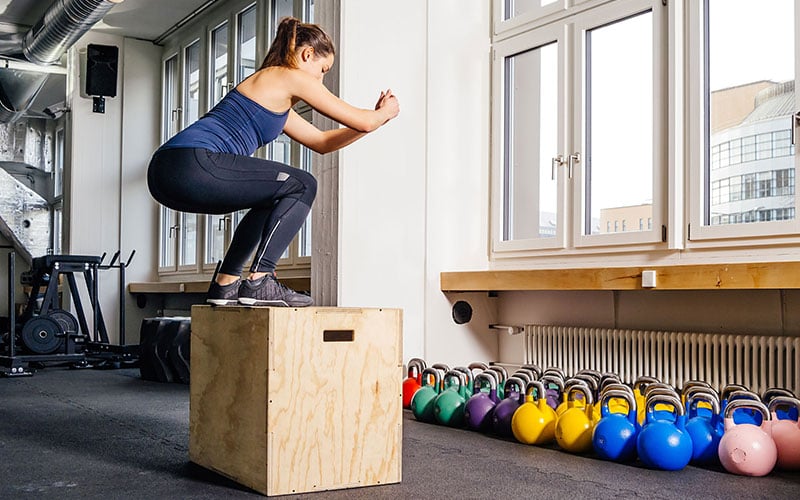
1. Box Jumps
Properly executed box jumps are a great way to train your entire body, especially energy transfer through the trunk muscles. Most importantly, it loads the tendons of the knees in an explosive yet controlled fashion that isn’t duplicated by way of any standard weight training exercise. Not even squats.
The difference between these and other box jumps you see at the gym done by boneheads with a platform and 50 risers is there are rules to keep you safe.
- Use your whole body: That includes a full arm swing and a complete body extension. It’s the best way to learn to transfer forces from the ground up.
- Land softly on the box: Try not to make a sound when you land. If your knees are bent more when you land than when you loaded for your takeoff, the box is too high.
- Step down off the box: Don’t jump down.
- Treat each rep like its own set: There’s no reason to rush anything, and the only part of the jump that should move quickly is the jump itself. That’s it.
2. Forward Bounding
Your connective tissue will benefit even more if you change the direction of force you produce. Once again, the weight room doesn’t do much for lifters from a dynamic standpoint (and for good muscle and strength gains, there’s not much we can do about this).
Channeling energy forward through explosive movements can simultaneously work the hip extensors and posterior chain while working on coordination and the conditioning of the knee and hip joint. Without a sprinting background, this may be harder to coordinate, but once you hit an open field to do these, pay attention to these rules:
- Aim for a full leg extension on your push off leg, and a high knee lift on your front leg.
- Don’t forget your arm drive. The harder you pump your arms, the better your trajectory.
- At first, don’t gun for the greatest distance or height. Focus on sharp movements and holding form.
- Aim for a very brief ground contact time. Your foot shouldn’t “stay” on the ground. It should pop off of it.
- Cut off your set after a maximum of 16 strides.
3. Lateral Bounding
Especially if you’re looking to play sports outside the weight room, the lateral bound may be one of the most important drills you master. Very few exercises in the weight room even approach this plane of direction, and ligaments like the LCL and MCL are often left hanging out to dry because of that.
The second quick directional changes are asked of an athlete on the court or field, a 400 pound squatter can be reduced to shambles because those specific capacities haven’t been conditioned. For the lateral bound:
- Before you focus on speed or jumping distance, focus on landing quality. Once again, attempt to land softly, absorb all impact, and keep your balance. If you can land on the foot without putting your other foot down for support, it’s a good thing.
- Be sure to use “running arms”. When you land on your right leg, your left arm should be up. Once you take off, the arm opposite your takeoff leg should pump hard to help you through.
- Feel free to play around with the combinations. You can do full sets of lateral bounds in one direction only, or you can alternate left to right. You can slowly edge your way forward as you bound laterally, or you can stay in place.
4. Plyometric Push Ups
These are fourth on the list, not because they’re the least important, but because they’re slightly more limited in their scope as far as athletic conditioning and movement preparation are concerned.
Still, plyo push ups are a great exercise on their own or as a finisher to a chest workout to make explosive work for the upper body – which is something that’s usually a lot more difficult to achieve compared to the endless leg exercises there are to accommodate this.
Related: 4 Killer Pushup Variations for Explosive Power
Because the chest and triceps are much smaller muscles than the quads, glutes and hamstrings, one thing that you can bet on is a faster burnout. You won’t last as long being explosive for every set, and for that reason, it’s important to pay attention to the moment your push up slows down, and kill the set once you get there.
And one more thing: Don’t clap while you’re in mid-air.
It only takes one missed rep for you to break your finger or sprain your wrist because you’re not quick enough to get back into position. Surely not worth the flash. Let your arms leave the ground and simply return to their starting point.
Conclusion
Remember, this is for the intermediates in the crowd. And here’s another thing. If you’re a big guy, you have all the more reason to really ease into this. Carrying around a lot of heavy muscle creates tremendous amounts of joint stress when you do anything – even going for a jog.
No matter how much you can lift in the weight room, you’ll always be at a slightly greater risk for error or injury if you don’t play it safe and build your way up to impressive numbers. That’s why many of the best jumpers in the athletic world aren’t heavyweights.
And remember, we’re not here to become athletes – just more athletic. There’s a difference. It takes an ego check and a dose of realism.