Plyometrics: The Missing Piece in Your Programming Puzzle

Do you write your own programs?
Unless you’re blessed to know an individual with an adequate knowledge of strength and conditioning or a background in exercise physiology, you’re going to have a tough time composing a solid training program which is designed for your individual weaknesses, preferences, and developmental stage.
The pursuit of strength and new muscle mass can often leave lifters stuck in a one track mindset. They run down the rabbit hole of only training with certain rep ranges, exercises, or protocols which can be somewhat deleterious in the end.
The human body is incredibly adaptive, and though repetition is needed for a trainee to ingrain patterns and get stronger, there’s a chance that stepping outside the structure of your typical routine can offer quite a number of benefits.
Related: Push Past your Training Plateaus!
You could follow a generic program outlined in an article but if you’re stuck on writing your own program, you should include the following.
Plyometrics
Most people think plyometrics are extremely complex, and thus only reserved for athletes or power sport competitors with no carryover to a classic, recreational lifter. However, I disagree for two reasons.
For starters, I personally believe that it’s a waste of time and energy to bust your balls at the gym every day to build a ton of nonfunctional muscle. If you’re strong and carry size, but don’t have the ability to run for a bus, or can’t even touch the rim on a basketball goal (let alone dribble without looking like a fool), then what’s the point of wanting to get bigger and stronger?
Regardless of your goal, it’s always important to retain your athleticism when you’re hitting the gym heavily. Losing your mobility or not training to be explosive are common problems in the lifting game.
Now it’s time to get into the nitty gritty.
Training with plyometrics means you’ll be incorporating jumps and unloaded explosive movements as a supplement to your program.
The good thing about this is that you’ll be exclusively hitting the fast twitch muscle fibers, controlled by your high threshold motor units. These are your strongest, largest muscle fibers you have available so making them more efficient will translate into higher recruitment potential during heavy squats, deadlifts, or other movements.
This is just one of the reasons training for low reps are recommended for power production and sets of 8-10 are the default for basic hypertrophy training. Plyometric training can help “trick” your musculature into working more efficiently when they’re loaded with weights, so you can get the most out of your sets.
Jump, Push, and Bound!
I’ll start this off with a disclaimer: Plyometric training requires healthy joints. If you’ve got a history of knee, hip and shoulder issues, there’s a good chance plyos may not be in the cards for you just yet. Focus on getting your injuries sorted out before attempting this stuff.
Related: Warming Up for Dummies: A Lifter's Guide to Injury Prevention
It doesn’t mean you’ve got to get fancy with your exercise selection – you’re not an Olympic long jumper. Keeping the movement choices simple and making sure they’re technically sound is step 1 for huge gains. The “shock” factor will be enough to spark results.
A couple of ground rules of plyometric training:
- You have to try as hard as you can. If you don't, this won't work. Every effort should be your max with good form.
- You've defeated the purpose when the repetitions slow down. If you can't still explode, it's time to rest. Plyometrics use the anaerobic energy system which depletes rather quickly. You won't be tapping into this system by doing reps for 60 seconds straight.
1. Box Jumps
It’s got to be the most misused and botched movement I’ve ever seen in the gym. I legitimately get angry when I see a fat loss client using box jumps for sets of 20 reps to get “conditioning”. It completely perverts the nature and importance of such a technical lift. Not only that, it can increase injury risk tenfold. Using a high box for box jumps (I consider “high” anything thigh – level and up), remember the following cues:
- Treat each rep as its own set. Freeze on the ground, and take a couple of seconds between jumps to charge up and prepare.
- Squat to a parallel depth and hold position. You should be still the instant before you explode.
- Remember to use a strong arm drive to help propel yourself upwards.
- Land in the same squat depth as you did when you took off. If your squat is notably deeper, the box may be too high.
- Land QUIETLY. You shouldn’t make a big noise on the box when you land. Brace and absorb your impact. This is also easier to do on a lower box.
- Remember to step off the box. Don’t jump down. Doing so is a hidden knee-saver.
That's a lot of cues, so check out this video for a visual:
2. Plyo Push Ups
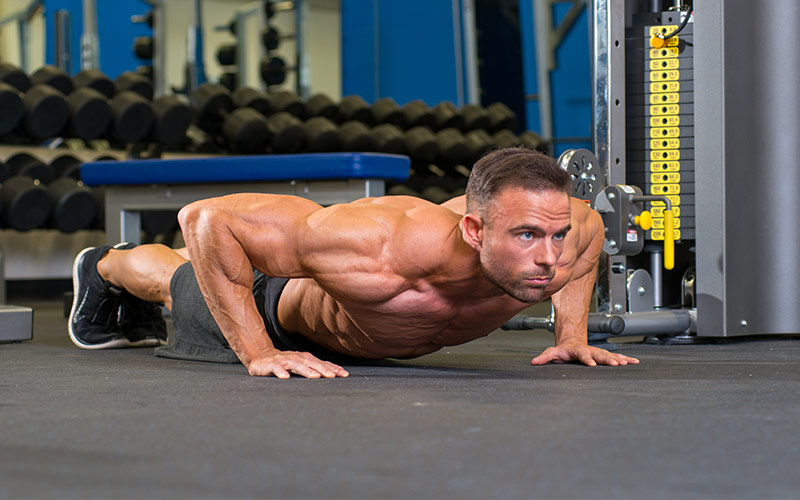
This one is simple. You do a pushup explosively enough for your hands to leave the floor on each rep. Be sure to absorb shock and brace your impact by landing quietly and continue into your next rep.
The number one mistake most people make? Attempting to clap the hands on every rep. It only takes one missed rep to result in broken fingers and a face-first landing. Instead, simply leave the hands shoulder-width apart as you take off from the ground.
Also, remember to stay tight just like you would during a normal push up. It’s a no-no to have the hips falling all over the place when performing them. There should always be a straight line from shoulder to heel. If that’s too difficult to do, start by elevating your hand position and doing your push-ups off of a sturdy low box or bench.
3. Bounding/Standing Broad Jumps
Both bounding drills and standing broad jumps are an excellent addition to lower body programming since they more appropriately will train hip extension. The glutes can easily be muted when attempting to travel upwards in a jump movement, but it’s much harder for them to be uninvolved when jumping forward.
If you’ve got the space, bounding while focusing on a full extension of the trailing leg is a great way to train this capacity, coupled with planted, two legged broad jumps. Remember to keep ground contact time to a minimum.
TIP: Use grass or rubber flooring for these exercises. Doing them on concrete or other hard flooring can negatively affect the health of your knee and hip joints, leading to unpleasant side effects.
Jump Into Some Muscle
The examples above are just the tip of the iceberg where plyometric training is concerned, but they’re necessary to get the most out of your strength training. Remember to use low rep ranges (no more than 6-8 reps) for all of the movements. It’s ok to keep the sets higher to compensate.
Remember, these aren’t meant to substitute your weight training. They’re meant to supplement it. Enhancing your gains by simply tapping into your explosive capacity will be the best move you made.