8-Week Advanced Muscle Building Workout for Women

Many lifters rotate through different training phases throughout the year. Some seasons focus on getting leaner, while others prioritize building muscle and strength. For women looking to enter a true hypertrophy phase, an advanced training program can help maximize progress and push past plateaus.
This 8-week advanced muscle-building workout for women is designed to increase overall strength while developing muscle in key areas, including the glutes, legs, back, and shoulders.
With consistent effort, proper nutrition, and adequate recovery, most trainees can expect measurable improvements in both performance and physique within two months.
Who This Advanced Women’s Workout Program Is For
This program is best suited for experienced lifters who are comfortable with proper exercise technique and higher training volume. The workouts include compound movements, unilateral exercises, and advanced muscle-building strategies that require focus and a strong mind-muscle connection.
Intermediate lifters who want to challenge themselves can still try the program, but the priority should always be movement quality. Slow, controlled repetitions and proper execution are more important than increasing weight too quickly. If any movement feels overly challenging, start lighter and focus on mastering the pattern before progressing.

Why This Is an Advanced Muscle Building Program
Compared to beginner or intermediate routines, this plan uses higher training volume and multiple exercises targeting similar muscle groups from different angles. The goal is hypertrophy, meaning muscle growth through progressive overload and consistent stimulus.
Each session contains enough volume to promote adaptation without isolating single muscle groups excessively. The structure allows muscles to be trained multiple times per week while still providing adequate recovery through strategic scheduling.
Training Split and Weekly Structure
The program follows an upper/lower body split performed on a two-day-on, one-day-off schedule. This format helps maintain high training intensity while allowing time for recovery between demanding sessions.
A typical weekly structure may look like:
- Monday: Day 1 - Lower Body and Core
- Tuesday: Day 2 - Upper Body
- Wednesday: Rest
- Thursday: Day 3 - Lower Body
- Friday: Day 4 - Upper Body
- Saturday: Rest
- Sunday: Optional Rest or Light Cardio
Training more than two consecutive days is not recommended because recovery plays a major role in muscle growth and long-term performance.
Rest Periods and Workout Duration
Because this is a high-volume hypertrophy program, rest periods should be long enough to maintain strength and performance across all sets. Two to three minutes of rest works best for most compound exercises such as squats, hip thrusts, presses, and rows. Secondary movements can use slightly shorter rest periods, while isolation exercises and core work generally require around one minute.
Most sessions will last between 60 and 90 minutes, depending on gym flow, warm-up time, and rest intervals. Lower body days tend to run longer due to the volume and overall fatigue involved.
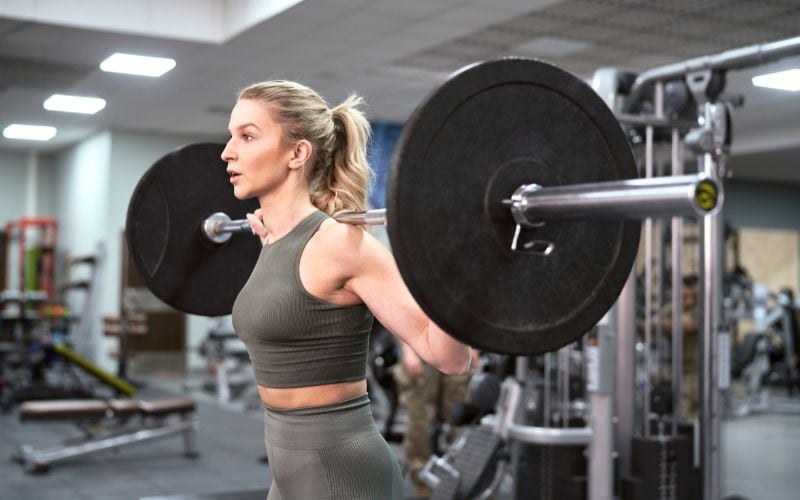
8-Week Advanced Muscle Building Workout for Women
Day 1: Lower Body and Core
Start with a 10-15 minute warm-up that includes light cardio, dynamic mobility, and controlled lower-body activation. The focus of this session is quad development, overall lower body strength, and core stability. Perform each repetition with a slow tempo and controlled movement. Training to absolute failure is not necessary; finishing within one or two reps of the target range is ideal for hypertrophy.
| Exercise | Sets | Reps | Rest |
|---|---|---|---|
| Dumbbell Step Up | 3 | 10-12 each leg | 90-120 sec |
| Barbell Back Squat | 3 | 10-12 | 2-3 min |
| Leg Press or Hack Squat | 3 | 10-12 | 2-3 min |
| Dumbbell Goblet Squat | 3 | 10-12 | 90-120 sec |
| Leg Extension | 3 | 15 | 60-75 sec |
| 45 Degree Leg Press Calf Raise | 3 | 15 | 60 sec |
| Weighted Crunch | 3 | 15 | 45-60 sec |
| Shoulder Taps | 3 | 10 taps each side | 45-60 sec |
Day 2: Upper Body
This upper body workout targets the back, chest, shoulders, and arms through a mix of pushing and pulling movements. Since there are two upper body sessions in the program, each uses different exercises to provide varied stimulus and promote balanced development.
If time is limited, certain exercises performed near each other in the gym can be structured into supersets. This approach can reduce session length without sacrificing training quality.
| Exercise | Sets | Reps | Rest |
|---|---|---|---|
| 3 | 10-12 | 2 min | |
| Seated Cable Row | 3 | 10-12 | 90-120 sec |
| Incline Dumbbell Bench Press | 3 | 10-12 | 2 min |
| Tricep Dip | 3 | 10-12 | 90-120 sec |
| Dumbbell Front Raise | 3 | 10-12 | 60 sec |
| Dumbbell Tricep Extension | 3 | 12-15 | 60-75 sec |
| Concentration Curl | 3 | 12-15 each arm | 60 sec |
| Hanging Leg Raise | 3 | 12-15 | 45-60 sec |
Day 3: Lower Body
The second lower body workout emphasizes the glutes, hamstrings, and posterior chain. This balanced structure helps prevent overuse while ensuring the entire lower body receives sufficient training stimulus throughout the week.
Some trainees may prefer starting the week with posterior chain work instead of quad-dominant training. Swapping the order is perfectly acceptable as long as an upper-body day separates the two lower-body sessions.
| Exercise | Sets | Reps | Rest |
|---|---|---|---|
| Hip Thrust | 3 | 10-12 | 2-3 min |
| Hip Abduction Machine | 3 | 10-12 | 60-75 sec |
| Romanian Deadlift | 3 | 10-12 | 2-3 min |
| Walking Lunge | 3 | 10-12 each | 90-120 sec |
| Lying Leg Curls | 3 | 12-15 | 60-75 sec |
| Seated Calf Raise | 3 | 15 | 60 sec |
| Glute Bridge Pallof Press | 3 | 12 | 60 sec |
| Side Plank | 3 | 40-60 sec each | 45-60 sec |
Day 4: Upper Body
The final workout of the training split reinforces total upper-body development. Shoulders, arms, chest, and back are trained through a mix of compound and isolation exercises. If a specific muscle group requires additional attention, an extra movement can be added at the end of the session to increase volume.
| Exercise | Sets | Reps | Rest |
|---|---|---|---|
| Incline Dumbbell Flys | 3 | 10-12 | 75–90 sec |
| Dumbbell Pullover | 3 | 10-12 | 90 sec |
| Arnold Press | 3 | 10-12 | 2 min |
| Dumbbell Lateral Raise | 3 | 10-12 | 60 sec |
| Skull Crushers | 3 | 15 | 60-75 sec |
| Rope Tricep Extension | 3 | 12-15 | 60-75 sec |
| Cable Curl | 3 | 10-12 | 60-75 sec |
| Wood Chop | 3 | 15 each | 45-60 sec |
Cardio Recommendations During a Muscle Building Phase
While the primary goal of this program is hypertrophy, cardiovascular training still plays an important role in maintaining heart health and controlling unwanted fat gain. Three to four weekly Zone 2 cardio sessions lasting around 30 minutes can support recovery and overall conditioning without interfering with strength progress.
These sessions can be performed either after resistance training or at a separate time during the day, depending on personal schedule and energy levels.

Nutrition and Recovery for Optimal Muscle Growth
Progress in any advanced muscle-building program depends heavily on nutrition and recovery habits. Adequate calorie intake and sufficient protein are necessary to support muscle repair and growth. High-quality whole foods should form the foundation of the diet, with supplements used only as supportive tools.
A surplus of approximately 300-500 calories per day is typically enough to support muscle growth without significant fat gain. Start by determining your maintenance intake using a BMR or TDEE calculator. Once you know your maintenance calories, add a moderate surplus and monitor progress weekly.
Prioritize nutrient-dense foods such as:
- Lean protein sources
- Eggs and dairy
- Fruits and vegetables
- Healthy fats (olive oil, nuts, seeds, avocado)
- Quality carbohydrates (rice, quinoa, lentils, oats, sweet potatoes, potatoes)
Whey protein and creatine monohydrate remain two of the most evidence-based supplement options for improving recovery and performance. Beyond nutrition, consistent sleep remains one of the most powerful recovery tools available. Most trainees should aim for seven to eight hours of quality sleep each night while also incorporating mobility work, stretching, and soft tissue work when needed.
Related: 8 Essential Muscle Building Supplements
Can This Program Be Used for Fat Loss?
Although designed primarily for muscle growth, this advanced women’s workout program can still be used during a fat-loss phase. The key is to adjust calorie intake while maintaining adequate protein intake to preserve muscle mass. Training intensity should remain high even when calories are reduced, though overall recovery strategies become even more important.
Sticking with moderate-intensity Zone 2 cardio is typically more sustainable during calorie deficits than high-intensity interval training, which may increase fatigue and reduce performance.