Unilateral Training: Building Muscle & Strength Without A Barbell

Brad Borland is a strength & conditioning specialist, cancer survivor and the founder of WorkoutLab.
If you’ve toiled away in the gym for any length of time you probably are a bit set in your ways. You have your trusty program at the ready pumping iron day in and day out with little thought of any drastic changes. What you are doing works well, in your mind, and why fix what isn’t broken, right?
But let’s be honest. Are your gains happening like you want them? Are you still progressing with significant results in strength and muscle? Or is something missing? Maybe you find that your old routine needs a little boost – a little shift for several reasons. Maybe you have a muscle pull here or a strained hip there or maybe your gains have completely stalled all together. Of course there is a cure and all it takes is a little honest self-evaluation and a bit of know-how.
Before I start talking about unilateral training and all of its advantages, let’s take a look at bilateral training and what it can teach us about what to fix and when. Bilateral training is just a fancy term for the more traditional lifts using a fixed bar or apparatus such as barbells and machines such as the leg press, hack squat and Smith machine among others. It is defined by utilizing both limbs (arms or legs) on said fixed bar or apparatus at the same time. The limbs are not independent of each other, but rather, are dependent on one another.
The barbell isn’t all that bad, is it?
One of, if not the, greatest inventions to mankind when it comes to building lean muscle is the barbell. Invented many decades ago, the barbell changed how society looked at exercise and has only grown in popularity since. It has been the staple tool for countless feats of strength in powerlifting, Olympic lifting and other new sports phenomena such as Crossfit. The results speak for themselves when looking at all of the great accomplishments of the barbell.
Some advantages you may already know of when using the barbell for bilateral exercise:
- The ability to lift heavier loads: Simply put, the barbell allows you to put more weight on the bar compared to other pieces of equipment. By using both limbs you are able to lift heavier than with each limb working independently.
- Use of a wealth of multi-joint movements: The number of exercises that you are able to use with a barbell is practically endless. The list not only includes bench presses, squats and rows, but also ab rollouts, overhead squats and suitcase carries.
- The practical and functional training effect: The barbell is an outright functional piece of equipment. Simplistic in nature, it has real-world application of lifting from the floor, overhead and pulling and pushing. It can be a one-stop shop for applicable movement.
- Efficiency: What is more efficient than a single piece of equipment? Able to be performed practically anywhere, the barbell makes a great addition to any home gym as well. No special accommodations needed, just a solid floor and you are ready to go!
- Cheap cost relative to other more advanced equipment: Normally a nicely stocked gym will have a steep price tag with additional upkeep costs included. The barbell, on the other hand, is a one-time relatively affordable purchase. Just purchase a few more plates as you advance.
- Universal application regarding numerous modes of training: As mentioned earlier, the barbell has been applied to a number of training modes such as powerlifting, Olympic lifting, bodybuilding, Crossfit and everything in between. Its universal use is only gaining steam as individuals seek more practical ways to train.
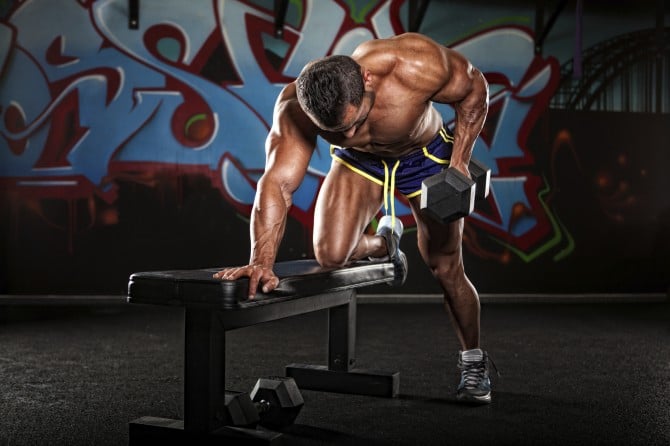
Now, what would a pros list be without the cons? Although the barbell (used for bilateral movements) is all that and a bag of chips, it does have a few chinks in its armor. When performing certain exercises such as squats, bench presses and shoulder presses it can present a few distinct disadvantages regarding strength, balance and injury. This also includes using machines that call for bilateral use such as the leg press, hack squat and chest press machines as well as many Smith machine exercises.
- Strength imbalance: The first glaring disadvantage of a bilateral exercise is the inability to shore-up strength imbalances. Not being able to unilaterally stress each side of the body independently will eventually develop a weak side. Which leads us to our next point.
- Injury risk: With an imbalance in strength the result will be a weak side and a strong side. The weak side will try desperately to keep up and eventually risk injury. The load will be too great and a strain, pull or even worse may occur. It will simply overcompensate for the lack of strength.
- Limited multi-angular movement: A bilateral movement also does not allow the ability for changes during the range of motion. Human movement is seldom on a fixed path and with your limbs in a fixed width pattern a more “3-D” range of motion is limited.
- Lack of a linear path: Related to the above, a barbell specifically does not allow for a direct linear path. In other words, for a shoulder press you have to clear your head before applying maximum force to the weight. The same holds true for barbell shrugs and pulldowns.
- Fixed grip: On barbell and machine exercises your grip is in a fixed plane. You will find that you are in a fixed grip with no ability to pronate or supinate into different angles of push or pull.
Enter unilateral training
Unilateral training brings into play a number of advantages to the bilateral challenges. Performing movements with independence can fix what’s broken. One would deduct that this type of training would exclusively use dumbbells, but barbells, bands, cables and even some machines can be utilized for your one-limb needs.
Bilateral training can:
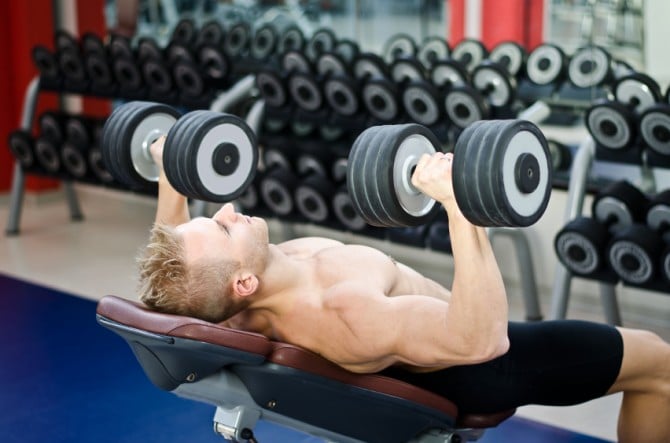
- Shore-up weaknesses: It’s a no brainer that unilateral training can provide the correct stimulus to make your weak side stronger. Many times, if you are ingrained yourself into exclusive barbell work for a period of time, you will find once you switch to a dumbbell press, for example, your balance and strength can be quite a challenge.
- Bring balance to your physique: Unilateral training can also bring an aesthetic as well as a strength balance to your body. One side is normally dominant over the other so working each side independently forces you to fill out the gaps in your physique.
- Relieve injury over time: Once balance is brought to light, you will quickly decrease your risk of injury and may also relieve some strains and tightness in other areas as well. You will create symmetrical and harmonious strength in the entire body. One side overcompensating for the other will be reduced.
- Add some much-needed variety: Who doesn’t like variety? Unilateral training can add a wealth of new moves and also put new spins on old ones. Different grip variations, angles, supination and pronation just to name a few.
- Enable multi-angular training: One of the greatest benefits is that you are freer to manipulate the weight, shift your angle and follow a variety of plains to stimulate the muscle in new ways. You have more freedom to execute movements as it relates to your specific body structure. You are not fixed into any specific range of motion.
- Broaden the scope of many exercises: As mentioned earlier, the door is wide open when it comes to the number of exercises. Also, the variations you are able to do with even the ones you are currently doing can be endless as well. Different angles, shifts in grip, angle of pull, stances and combinations are just a few advantages. Experiment and challenge yourself to get creative.
Can’t we all just get along?
So, have we concluded that all unilateral training is better and that we should dump all of our barbells in the trash? Not necessarily. The point is to select a few from each camp of thought so you have a comprehensive workout plan. One that will stimulate the muscle in an efficient way without too much fluff. One that will give you all the tools you need to build the body you want. And one that will broaden your horizons a bit so you can design your own plan of attack.
Below is a short list of some of the more common (and possibly not so common to you) exercises and their unilateral “fixes.” This isn’t an exhaustive list by any means but you will quickly see how unilateral training can measure up for more muscle.
Barbell and machine bench press: Flat and incline bench dumbbell press, one-arm dumbbell press, dumbbell floor press, TRX fly and press/push-up, neutral grip dumbbell press, one-arm kettlebell press and dumbbell flys.
- Barbell and machine rows: Dumbbell two-arm row, single dumbbell row, one arm TRX pull, one-arm pulldown, one arm cable row, one-arm kettlebell row, Renegade row, one-arm T-bar row and dumbbell deadlift.
- Barbell and Smith machine shoulder press: two-arm dumbbell press, one-arm dumbbell press, kettlebell press, all lateral dumbbell movements, Arnold press, neutral grip dumbbell press and dumbbell upright rows.
- Barbell, preacher and machine curls: Incline bench supinating curl, dumbbell spider curl, dumbbell preacher curl, TRX curl, standing dumbbell curl and hang curl.
- Barbell triceps extensions and close-grip bench press: Lying dumbbell extension, TRX triceps extension, one-arm cable pressdown, one arm overhead dumbbell extension and one-arm triceps press on machine.
- Barbell squat and leg press: Bulgarian split squat, pistol squat, one-legged leg press, all forms of lunges, step-ups, split squat and jump split squats.
- Leg curls and Romanian deadlifts: Single leg curl, single leg Romanian deadlift, single leg rollout, standing single leg curl and lunges.
- Standing and seated calf raise: Single-leg standing calf raise, single leg press calf raise and single leg seated calf raise.
Now, that you understand a little more about the good, the bad and the ugly, how do you fit all of this into an effective training plan? How can you structure your training in such a way as to encompass all of these important variables so you can build your ultimate physique? Below is a sample workout built around using the big lifts as well as added unilateral training to insure your physique of balanced strength and muscle.
Perform each training day once per week.
| Day 1 | |||
|---|---|---|---|
| Chest, Back & Shoulders | |||
| Exercise | Warm Up Sets | Work Sets | Rest (Sec) |
| Incline bench dumbbell press | 2 x 12 | 4 x 6-10 | 60 |
| TRX chest press | 3 x AMAP | 60 | |
| Two-arm dumbbell row | 2 x 12 | 4 x 10-12 | 60 |
| TRX row | 3 x AMAP | 60 | |
| Dumbbell upright row | 3 x 10-12 | 60 | |
| Arnold press | 3 x 10-12 | 60 | |
| Day 2 | |||
|---|---|---|---|
| Arms & Legs | |||
| Exercise | Warm Up Sets | Work Sets | Rest (Sec) |
| Dumbbell spider curl | 1 x 12 | 3 x 10-12 | 60 |
| Dumbbell lying triceps extension | 1 x 12 | 3 x 10-12 | 60 |
| Single leg standing calf raise | 1 x 12 | 3 x 10-12 | No rest |
| Barbell Bulgarian split squat | 2 x 12 | 4 x 6-10 | 60 |
| Walking lunge | 3 lengths | 60 | |
| Single-leg curl | 3 x 6-10 | 30 | |
| Day 3 | |||
|---|---|---|---|
| Chest, Back & Shoulders | |||
| Exercise | Warm Up Sets | Work Sets | Rest (Sec) |
| Flat bench dumbbell press | 2 x 12 | 4 x 8-12 | 60 |
| Incline barbell press | 3 x 6-10 | 60 | |
| Dumbbell deadlift | 2 x 12 | 4 x 6-10 | 60 |
| Inverted row | 3 x AMAP | 60 | |
| Standing dumbbell shoulder press | 3 x 6-10 | 60 | |
| Bent-over dumbbell lateral raise | 3 x 10-12 | 60 | |
| Day 4 | |||
|---|---|---|---|
| Arms & Legs | |||
| Exercise | Warm Up Sets | Work Sets | Rest (Sec) |
| Incline bench curl | 1 x 12 | 3 x 6-10 | 60 |
| Overhead dumbbell triceps extension | 1 x 12 | 3 x 6-10 | 60 |
| Single leg calf raise on leg press | 1 x 12 | 3 x 10-12 | No rest |
| Step-ups with dumbbells | 2 x 12 | 4 x 10-12 | 60 |
| Barbell front squat | 3 x 6-10 | 60 | |
| Single leg Romanian deadlift | 3 x 6-10 | 30 | |