The Ultimate Guide to Neural Adaptation Training (NAT)

Speed and power are displays of strength training that have developed from greater force production.
However, this depends on your nervous systems ability to stimulate muscles.
Like Charles Poliquin says, “The more strength you have, the faster and more powerful you can become from subsequent training”.
What is NAT?
NAT strengthens and develops your neural drive to maximize your neurological potential. By focusing on eccentric contractions, slow tempos, and pauses, you create the most effective NAT.
These factors are what highly stimulate tension in the nervous system and are the pillars of speed and power. Performing speed, power, or plyometric workouts prior to neural adaptation training is simply not helpful or practical.
How NAT Works
Performing high intense slow eccentric contractions with pauses increases the rate of force.
As a result, tendon and muscle increase stiffness (stiffness in a good way) and amplify and augment synaptic firing; something concentric contractions do not do very well.
Related: Max Adaptation Upper Lower (MAUL) Workout
How NAT Strengthens Neural Drive
NAT works by using two exercises. The first exercise produces a high amount of tension. This tension stimulates and sensitizes the neural sensors that power neural drive. During the second exercise, the muscles use the neural drive.
Let's use the squat as an example. In the first exercise, you will perform 3-5 reps of slow eccentric squats: 4 seconds squatting down and 2 seconds pausing at the bottom.
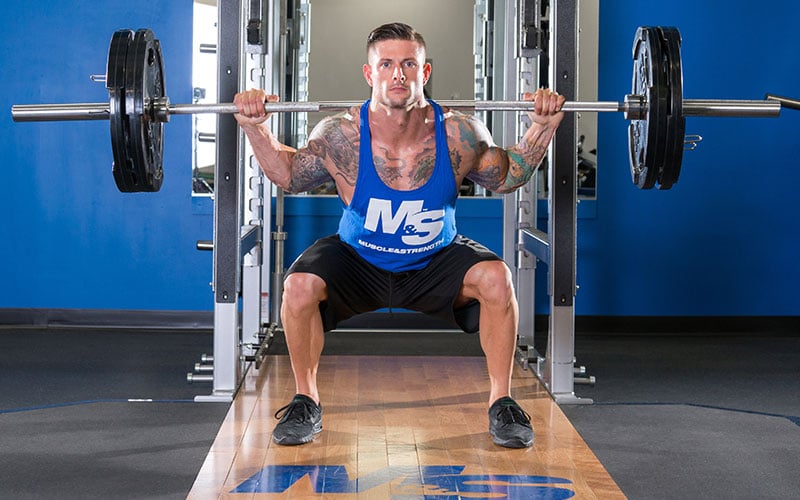
The time under tension during the eccentric contraction increases the stimulation and sensitivity of muscle spindles. (Muscle spindles are tiny sensors attached to muscle fibers that are activated by stretching). The more tension that increases during the stretch results in an increased recruitment of muscle spindles and muscle fibers.
The integration of tension and stretch produces something called elastic energy. This elastic energy builds-up and gets stored from performing eccentric contractions. To make this clearer, imagine pulling back a rubber band. When you pull the rubber band back, it stores elastic energy when stretched, and this is the idea that sets-up the second exercise.
Now imagine, letting the rubber band go. The storage of elastic energy from the first exercise is unloaded into the second. The build up of elastic energy from the eccentric phase makes the concentric phase faster and more powerful than normal and not vice-versa; the reason people become stronger instantly.
There is only one condition you need to know; the time for elastic energy storage is short. Therefore, your recovery is short between the two exercise and you have to use it instantly in your concentric movement. The longer you wait the more it will dissipate.
Just remember, the further you stretch the rubber band, the more elastic energy builds up and that allows it to shoot further through the air. This same principal applies to our muscles to produce speed and power.
Many strength researchers and sport scientists’ show through their research that eccentric training is the best method to enhance strength levels in athletes because of the instant boost it gives to their nervous system. And, this boost is the facilitation for speed and power. Research has also shown that slow eccentric squats improve higher jumping ability, the cross training of exercises and your squat rep max instantly.
Another study showed that between two groups, eccentric and concentric, the eccentric group recruited 10 times more fast-twitch fibers than the concentric group. The concentric group also experienced lower levels of hypertrophy. Concentric is essential but more results are gained, produced and transferred from eccentric to concentric.
The NAT Program
- For the first exercise, use your 5-rep max with a 4 second eccentric contraction and a 2 second pause at the bottom.
- For the second exercise use your 5-rep max and perform fast. No pauses. You should feel lighter and faster and the ability to do 1-3 reps more than your 5-rep max.
- Rest no more than 20 seconds between the two exercises and rest 3 minutes after each set to get full ATP recovery.
Strength Training Exercise Examples
Below are a couple of exercise pairings that you can use as examples on how to incorporate NAT into your own workout program.
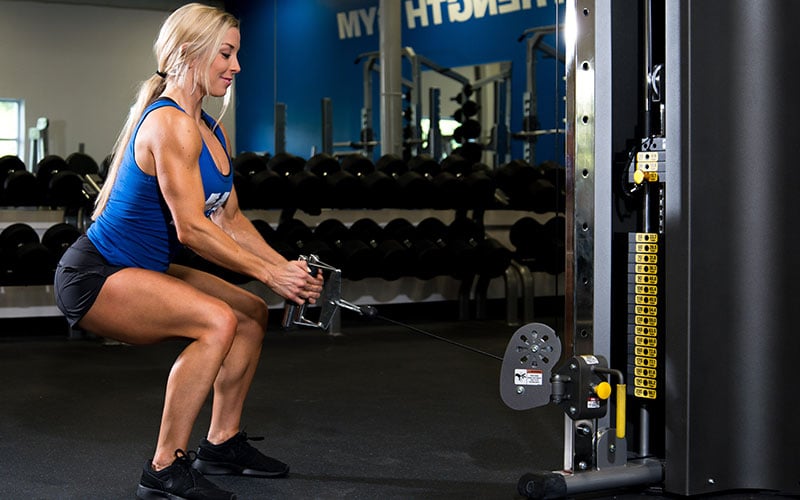
Eccentric Squats/ Farmer Squats
- Use a cable or resistance band and squat slowly using your 5-rep max. Focus on the eccentric motion and pause.
- Slowly squat to the floor using a 4 second count.
- Pause at the bottom for 2 seconds and then rise-up to the midpoint position of the squat slowly. You don’t need to stand up completely straight, just about halfway or a little above halfway. Keep the knees bent to stay focused in the eccentric phase.
- Inhale as you descend to the floor. Exhale hiss as you come up.
- Perform 3-5 reps.
- Rest 15-20 seconds after the slow eccentric squats and then perform the second exercise using your 5-rep max squat fast.
This trains the proprioceptive system to be stronger and more reactive.
Related: The Perfect Superset - A Simple & Effective Template
Stiff Legged Dead Lifts /Nordic Hip Bridges
- Using your 5-rep max, perform slow stiff legged deadlifts using a 4 second descent to the floor.
- Pause at the bottom for 2 seconds and then rise-up slowly.
- Inhale as you descend down to the floor. Exhale hiss as you come up.
- Perform 3-5 reps.
- Rest 15-20 seconds after the stiff legged deadlift and then perform NHB.
NAT is great to be effective for plyometric training and decreases the chance of injury associated to plyometric training. Injury occurs mainly because of poor preparation before adding intensity.
Regardless of injury, I know many people who try to do plyometric training prior to neural adaptation training first and they do not feel the speed and power transition through the exercises, the elastic effect.
But after neural development, they have the neural drive to perform plyometric training effectively, feeling the elasticity in the movement.
References
- Hedayatpour, N., & Falla, D. (2015). Physiological and Neural Adaptations to EccentricExercise: Mechanisms and Considerations for Training. BioMed Research International, 2015, 193741. http://doi.org/10.1155/2015/193741
- Neural Adaptations to Resistance Training Implications for Movement Control Timothy J. Carroll, Stephan Riek and Richard G. Carson Sports Med 2001; 31 (12): 829-840 0112-1642/01/0012-0829
- Using Additional Eccentric Loads To Increase Concentric Performance In The Bench Throw; Sheppard, Jeremy M; Young, Kieran; The Journal Of Strength & Conditioning Research: October 2010 - Volume 24 - Issue 10 - P 2853-2856; Doi:10.1519/JSC.0b013e3181e2731b Research Note
- Aboodarda, S. J., Page, P. A., & Behm, D. G. (2015). ECCENTRIC AND CONCENTRIC JUMPING PERFORMANCE DURING AUGMENTED JUMPS WITH ELASTIC RESISTANCE: A META‐ANALYSIS. International Journal of Sports Physical Therapy, 10(6), 839–849.
- Boost Performance by Knowing How to Boost Power, Poliquin Group, Editorial Staff, 1/29/2013;http://main.poliquingroup.com/ArticlesMultimedia/Articles/Article/966/Bo...