Band Resisted Deadlifts: Build Explosive Power and Massive Quads

Key Ideas
- The trap bar is the ultimate work-around tool with lifters with shoddy backs from squats and deadlifts.
- Since the loading is centered with the body rather than in front, trap bar deadlifts have less shear spinal stress than conventional deadlifts.
- By adding bands, we take a great exercise and add make it an even better muscle and strength builder.
The trap bar has taken gyms everywhere by storm. Even commercial gyms that scoffed at the idea of “intense training” years ago are buying the bars for their back friendly design.
Best of all, the trap bar is a hybrid between the squat and deadlift, allowing you to train nearly every muscle in your body with significant load to build muscle and strength. But there’s a way to make the trap bar even better: using bands.
Trap Bar Basics
Back Friendly
We all love the barbell squat and deadlift, but they’re both problematic for lower back health.
We can argue about technique all day, but the truth remains: more lifters get jacked up on squats and deadlifts than any other lifts.
Related: Squats Hurt Your Back? Here's 7 Pain Free Alternatives
The shape of the trap bar allows you to keep the weight centered with the middle of your body, rather than having the weight out front and increasing shear stress. This set-up keeps your torso more upright, like front squats compared to back squats.
With this position, your hips sit lower than the conventional deadlifts, giving you greater leg drive and knee flexion with less lumbar and hip extension. Altogether, you keep the bar inline with the middle of your body, use greater leg-drive, and less hip and back extension. Hip extension is obviously important, and I'll cover how to make it up later on.
Accelerated Learning Curve
For the majority of the couch-jockey population, getting into a proper deadlift or squat position is as easy as getting Donald Trump to break bread with ISIS.
More often than not, it takes months of mobility work and a refined coaching eye to get it right. This is important, and if you can’t get into position to pick weights off the ground you’ll be in rough shape later in life. But, while you’re grooving that ability, use the trap bar in training.
Seriously, the set-up is so easy, even a caveman could do it. Stand in the middle of the loaded bar, drop into a squat position while grabbing the handles, brace your abs to protect the lumbar spine, and stand up. Within five minutes, you can have form that's 90% perfect on the trap bar and be knocking out sets.
Lift Heavy, Recruit More Motor Units
We all love to lift heavy weights and tweet about our latest P.R. Well, maybe that’s just me, but the trap bar deadlift lets you pile on huge weight compared to your typical squat and deadlift.
Related: Deadlift Domination - How To Hit Your Biggest Pull Yet
Although it’s a different lift, your body knows heavy resistance. You can teach your body to maintain position and improve the firing of individual fibers within those muscles.
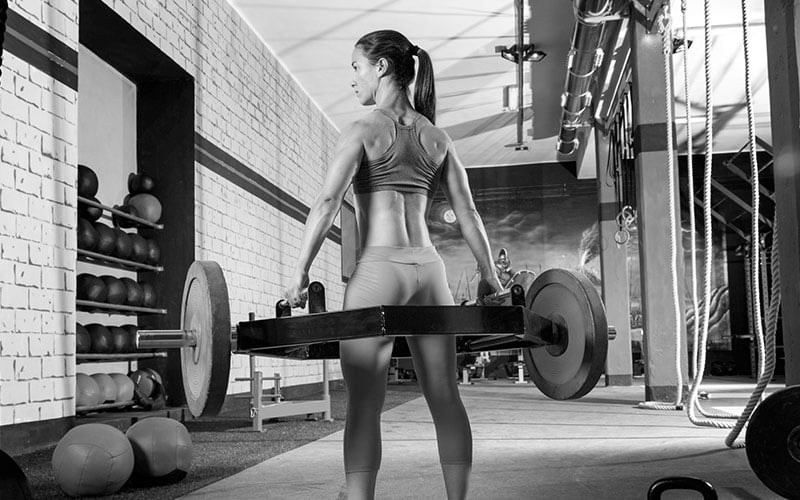
Further, since you're using more resistance you can improve motor unit recruitment in the same muscles and squat/deadlift movement pattern. While the biomechanics aren't identical, recruiting more motor units is always a good thing. This sets the table for greater improvements in squat/hip extension movements like squats, deadlifts, and jumps.
Full Acceleration
The trap bar deadlift is a great exercise, but once you pass your sticking point, a large chunk of time is spent decelerating the bar, even when lifting with explosive intent. This is a natural mechanism to prevent injury that, unfortunately, can reduce power.
That’s where bands come in and provide overload through the full range of motion. With bands, you're forced to accelerate all the way though hip extension, strengthening the glutes and hamstrings and building more power.
Band Resisted Trap Bar Deadlifts
There are two ways to set up your bands:
- Use one ¼ or 1 inch band wrapped around both ends of the trap bar and stand on the middle. Make sure your mid-foot is centered over the band when lifting.
- Use a band anchored on each side of the trap bar and hook to a power rack or dumbbells.
Make sure you know the strength of the bands and factor the tension into your training numbers.
Weight on the Bar + Tension from Band = Total Load
Benefits of Band Resisted Trap bar Deadlifts
1. Overload at your strongest points of a lift
The setup for trap bar deadlifts uses a lower hip position with greater knee flexion, which creates a higher demand on the knee and ankle, while decreasing hip extension. By incorporating a band, you’ll overload the concentric and, more importantly, increase the demand for hip extension at the top of the movement.
Most lifters actually get stuck at the bottom of their lifts and are plenty strong through hip extension, but they can never get there.
Using the bands allows you to train with loads you can handle off the ground, yet provides huge resistance at the top end of the movement that’s missing.
Bottom Line: Overload the lockout of your deadlift for stronger and bigger glutes and hamstrings.
2. Overloaded Eccentric Stress
Once you’ve completed the concentric part of the lift, the band is at full stretch. This is a huge eccentric challenge because the bands actively pull you back to the ground.
Essentially, this works like a heavy negative at the top end of the lift, forcing you to maintain body position under maximal load.
This does three important things:
- Teaches the body to reinforce technique under heavy loading. Holding proper technique with huge weights is imperative for injury prevention.
- Overload the strongest portion of your lift, which is often under-trained due to your sticking point off the floor. Stronger hip extensors and more muscular glutes are always a good thing.
- Increased Mechanical Tension. By lowering the bar under control while it’s trying to slam you ground, you provide a huge overloaded eccentric that creates tons of mechanical tension. Mechanical tension is a huge driver of muscle growth.
3. Increased Time Under Tension for Growth
The accommodating resistance provided by the bands increases the time of each rep. As the hips extend to lockout, the forcible stretch by the band slows down your rep speed. Further, the overloaded eccentric forces you to hold body position and lower the weight under control to complete each rep.
Increasing the duration of each rep by 1-2 seconds might not sound like much, but one set of five would be an extra 10 seconds of overloaded tension. Multiplied by 3-5 sets and you have 30-50 seconds of overload—a huge muscle-building stimulus.
4. Decreased Weight at the Bottom of the LIft
You’re probably thinking: If my weak-point is off the floor why would I want less resistance?
I hear you, here’s a different perspective:
The place most deadlifts go wrong is the initial pull. We’ve all seen it happen: the hips shoot straight up, lumbar and cervical flexion galore, and the weight stays plastered on the floor while the lifter hobbles away like Quasimodo.
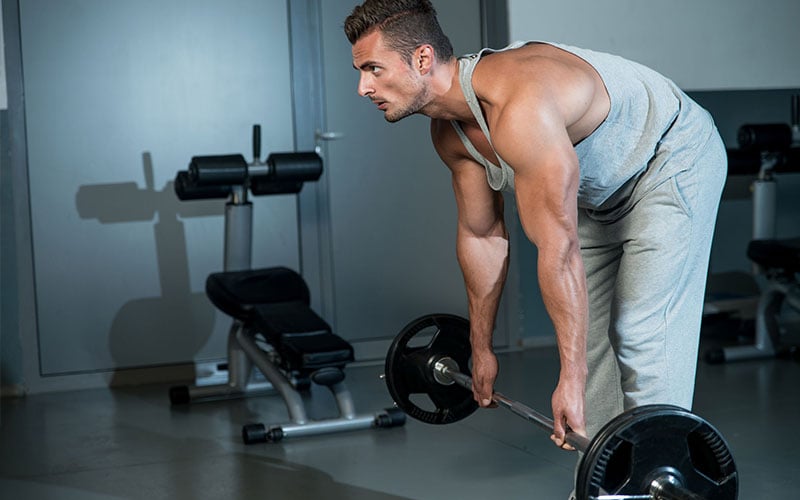
Don't be like this lifter.
Even though the trap bar keeps resistance in a neutral position and reduces shear stress on the spine, mobility restrictions still limit lifters from pulling safely, particularly from the low-bar position. If a lifter can’t keep a neutral spine when pulling from the ground, bands provide an opportunity to train the initial pull with less weight, will still overloading the quads, glutes, hamstrings, and erectors with reduced injury risk.
For this reason, I find the band resisted trap-bar deadlift awesome for my older guys who want to “feel” heavy weight without it pissing off their backs.
Mix Up Your Training For Big Results
The back squat and barbell deadlift are excellent exercises. If you’re competing on the platform, by all means keep them as your focus. But, should you want to lift huge weights without tweaking your back, add muscle to your quads, hams, glutes, and lower back, or just switch things up, then the Band Resisted Trap Bar Deadlifts are an excellent choice.