5 Best Calf Exercises: How to Increase Calf Mass

Calves seem to be the most overlooked body part in the lower body.
The muscle groups of your upper legs may very well support the core muscles of your body when you’re lifting but the lower leg muscles of the calves must work hard to stabilize the body through every movement while bearing the total weight of the body and any additional loads – twisting, raising you up onto your toes, lowering your onto your heels, twisting your feet.
It’s vital that your
Likewise, it does little good to train the rest of your body but leave your calves alone. You won’t be able to effectively stabilize the weights you’re moving and lifting outside of general workouts – meaning there’s no practical application for your muscle mass. Worst of all you will look like you’ve got chicken legs.
You cant even rely on the best upper leg
Start working through these top 5 exercises for increasing your calf muscles to ensure that you establish and maintain a well-rounded workout.
The Anatomy of the Calf Muscle
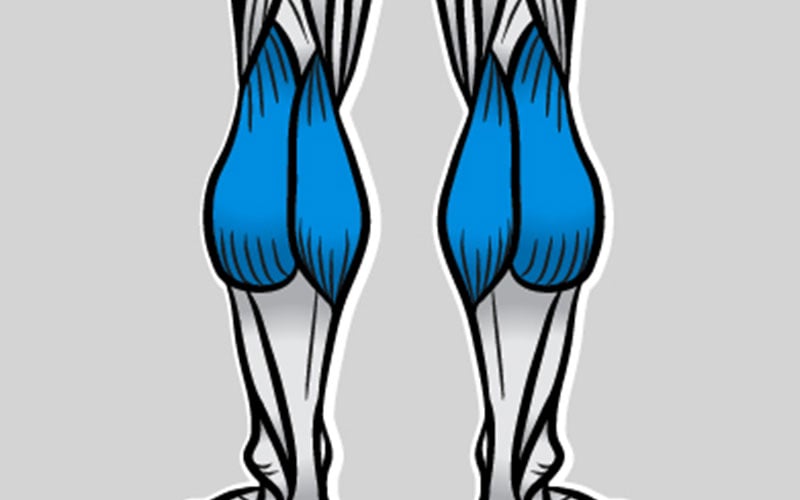
The calf muscle is a group of muscles that are balled into a large group in the upper portion of the lower leg just below the knee. This group is made up of 2 muscles that combine to make up the whole of the calf muscle.
- Gastrocnemius – The calf muscle that is most visible from the exterior of the body. This muscle attaches at the Achilles tendon and originates just behind the knee on the femur where it crosses the knee joint
- Soleus – This is a deep muscle that is not visible when looking at the leg externally. It lies beneath the gastrocnemius on the rear portion of the lower leg.
The function of the two muscles together is the elevate the heel both with the leg straight and when the knee is bent. The action of bending the heal is used in a variety of movements – walking, jumping, running,
5 Calf Exercises for Increasing Calf Muscle Mass
The calf muscles can be worked in a variety of ways but they are a specialized muscle group that receive very little activity and attention unless they are specifically targeted. These top 5
Some of these exercises require the use of weights while others use little more than natural physical resistance.
For additional resistance in any exercise you can add additional weight by using body straps or free weights (or by increasing the resistance of a
Top Calf Exercise #1: Standing Calf Raises
This exercise can be done using either a dedicated machine or a calf block. The number of reps you do for this exercise will vary depending on your current calf mass and workout routine. Test different ranges to see which works for the density of your calf muscles.
Stand under the machine pads or bar with the balls of your feet on the calf block. Start with your heels low, approximately 2 to 4 inches below the block. This will offer the best stretch on your
Top Calf Exercise #2: Seated Calf Raise
This is a calf exercise that is necessary to achieve complete development of the calf muscles. While this movement is similar to the standing calf raise, the
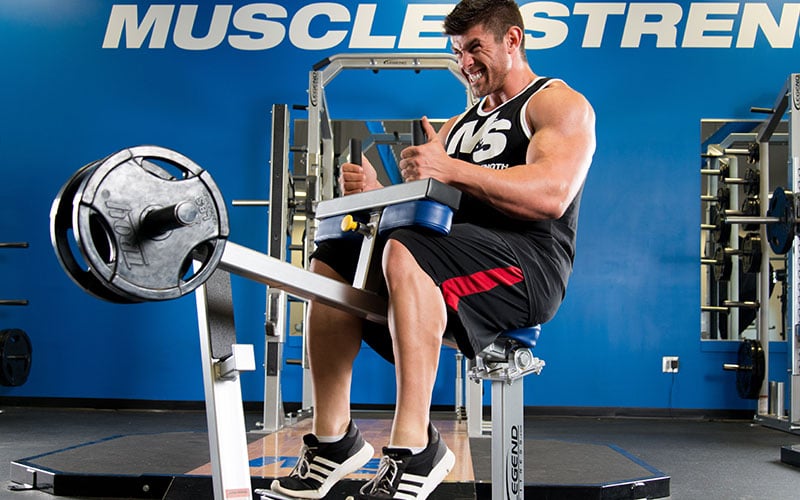
Sit with the machine pads resting on your thighs. Again, drop your heel to 2-4 inches depending on how flexible you are. Raise again and squeeze the calf muscles once you reach the top. The rep range for this workout, as well as the standing calf raise, should between 10 and 20 depending on the needs of your body and what you can tolerate.
Top Calf Exercise #3: Leg Press Calf Raises
This is a tried and true exercise that has been in use for years known also as the
Sit on the leg press machine and hold the sled with only your toes and the balls of your feet. Do not move with your hips or knees and instead put all the movement into your ankles. This puts all the emphasis on your calf muscles and nowhere else in the leg.
Top Calf Exercise #4: Box Jumps
In many lifting exercises you need to have explosive
Stand on the balls of your feet and you toes in front of a box, with the height appropriate to your limitations. Jump onto the box and land again on your toes and the balls of your feet. Jump back down to the floor and repeat for 8 to 10 reps. Do not use
Top Calf Exercise #5: Jump Squat
While this movement does also work the upper leg muscles it focuses a great deal of attention on the calf muscles as well and is an integral part of any whole body workout. Like the
To perform, simply place yourself in a position for a standard squat and lower your body into the squat, moving to the balls of your feet and toes as you do so. Once you’re at your lowest point, propel yourself up and explode upward into a jump. Land on the balls of your feet and immediately move into another squat. Add
Calf Workouts to Build Calf Mass
So, how do we put this all together in constructive workouts that’ll promote calf muscle growth?
Well, it really depends on your individual experience level.
Below, we’ve used the calf exercises mentioned above to develop a plan that will help you grow calf mass.
It follows a very simple volume progression that will take a beginner who is struggling to grow their calves to an advanced program to help those with calf mass grow even bigger calves.
Simply start by adding the workout category you fall into after your lower body workouts. Every other week add it to another one of your workouts. Once you’re training your calves after most of your workouts, progress to the next experience level.
Take the same approach with the following calf workouts. Start out by adding them to your lower body workouts. Every other week, add it to an additional workout day. And again, once you’re performing it after nearly all of your training days, progress again.
Once you’ve done this with the advanced workout, continue to progress by adding weight to the weighted exercises or by adding reps and/or sets to the non-weighted exercises.
It’ll take time, but if you commit to training your calves frequently, you’ll see the calf growth you’re looking for.
Beginner Calf Mass Workout
| Exercise | Sets | Reps |
|---|---|---|
| Standing Calf Raises | 2 | 12 |
| Seated Calf Raises | 2 | 15 |
Intermediate Calf Mass Workout
| Exercise | Sets | Reps |
|---|---|---|
| Standing Calf Raise | 3 | 12, 10, 8 |
| Leg Press Calf Raise | 2 | 10 |
| Seated Calf Raises | 1* | 20 |
*Perform a drop set.
Advanced Calf Mass Workout
| Exercise | Sets | Reps |
|---|---|---|
| Box Jumps | 1 | 15 |
| Seated Calf Raises | 3 | 15 |
| Leg Press Calf Raise | 2 | 12 |
| Standing Calf Raises | 2 | 10, 8 |
| Dumbbell Jump Squats | 1 | 15 |
You’ll see the best results by adding the top exercises to build your calf muscles to your usual leg workout routine. When working on increasing muscle mass in the lower legs, remember that it’s important to take in the proper amount of nutrients and protein to sustain your exercises and never push yourself beyond your daily limit. Give your body the appropriate time to rest and recover between each workout session as a damaged muscle group is a useless muscle group.
Frequently Asked Questions about Calf Training
Now that we’ve discussed some of the best calf exercises you can add to your training and example calf workouts you can start implementing right away, let’s review some of the most frequently asked questions when it comes to calf training.
Calf training can be quite confusing. As we’ve already outlined in this article, for those who aren’t genetically blessed with big calves, it takes a unique training strategy to grow them.
And since training can be so highly individualized, a lot of trainers and fitness icons make blanket statements about how to grow your calves.
They don’t mean any harm in doing so – but it can be confusing for the recreational lifter.
Check out the most common questions (per google) for an expert’s opinion on the matter. If you have any additional questions after reading them, feel free to comment below. We may decide to add it to this list in the future to help out others like yourself.
1. How can I increase my calf size?
The best way to increase your calf size is to focus on a well-designed workout routine that focuses primarily on improving upon compound lifts that work the entire body.
Once this is achieved, you’ll then want to add isolation work that directly targets the calves. Once you’ve began isolating your calves during your leg workouts, you may want to increase training frequency to promote more growth.
Once you’ve maxed out on the frequency in which you can train your calves and still adequately recover, you’ll want to progress by increasing volume and/or the weight used.
2. Are big calves genetic?
Yes. And no.
When it comes to muscle insertions and the ability to build muscle mass, a lot of it boils down to genetics.
However, that fact shouldn’t discourage you from trying to maximize whatever natural growth you were born with and are capable of through training.
Finding the right training program that incorporates that proper calf exercises for you, the appropriate amount of training volume, intensity, and frequency will allow you to build the muscles of the calves.
3. What is a good calf workout?
Any of the calf mass workouts listed above would be a good place to start right away. As you get more familiar with your body and your preferred training routine, you can modify them to better fit your individual training needs.
In short, a good calf workout is a workout that is paired with a good workout routine. From there, it isolates the muscles of the calf utilizing calf exercises that specifically work best for you. These calf exercises also utilize different leg positioning and feet positioning to target both calf muscles based on your individual needs for development.
Since the calves are comprised of both fast and slow twitch muscles, it’s important to train them with variety and frequently to make them grow optimally.
The exact volume, intensity and frequency in which you train your calves will depend on you as an individual.
4. How often should you train calves for mass?
It really depends on you as an individual – your genetic propensity for building your calves, the frequency in which you normally train, and your ability to recover from a higher training frequency when it comes to isolating the calves.
The calves are one of the few muscle groups that can be trained daily. Often times you do indirectly without even knowing it.
So, you can train them as frequently as your program allows so long as you are able to recover efficiently from the training stimulus.
5. Will calf raises increase calf size?
Absolutely. Calf raise variations are excellent exercises for isolating the calves.
However, the way you program them into your workout based on your individual needs is how you’ll experience their benefits.
Performing aimless unfocused sets of calf raises with an ineffective rep tempo and range of motion will do little to build calf mass.
However, figuring out an appropriate training volume and performing each rep with a slow tempo and full range of motion with emphasized stretches and contractions will add tons of calf mass.
6. Do squats increase calf size?
Squat variations do indirectly target the muscle of the calves, as do any lower body exercise. Some who are genetically gifted may be able to get away with building their calves strictly by progressing with lower body exercises such as the squat.
For most, however, some calf isolation exercises will be necessary to maximize the total amount of calf mass they’re able to grow.
However, getting stronger at exercises such as the squat is still critically important for building bigger calves. That is why the majority of answers in this FAQ section have mentioned the importance of prioritizing a balanced workout routine first and foremost and then adding calf isolation work to optimize progress.
7. Will losing weight reduce calf size?
During weight loss phases, you’ll typically lose a small amount of muscle size – even if you do everything right when it comes to slow and steady dieting with a priority on protein intake.
The best way to minimize this loss in calf size is by still training heavy during your compound lifts and continuing your calf training protocol during your fat loss phases. Doing so, paired with a proper diet focused on moderately high protein intake will preserve your lean muscle tissue.
8. Why do I have huge calves?
You’re genetically blessed.
No need to rub it in.
9. Can walking slim calves?
Any form of upright cardio that requires a lot of repetitive motion will actually build the muscles of the calves.
In fact, a lot of people will implement jump roping and jogging as their primary form of cardio and walking on their rest/active recovery days away from the gym to target the calves with a little more frequency.
Biking can also accomplish this, with an even greater emphasis on the soleus as a portion of the movement is in the bent leg position.
So, if you’re looking to shape your calves and maximize your efforts by means of a cardio activity, don’t hesitate to add in walking, jogging, jump roping, or biking.
10. How many calf raises should I do to get bigger calves?
I’m going to reference my answer to number 5 on this one.
There won’t be any magic number when it comes to how many calf raises you should do to promote calf mass. Although the workouts listed earlier in the article are a good starting point, everyone is different.
And the actual calf raise movement pattern will be rather meaningless if you’re not controlling tempo and performing them with a good range of motion.
Start with the calf workouts mentioned earlier. Once you’ve conquered that, experiment. Find the best exercises for you, play around with volume and frequency to find what works best for you, and always aim to progress this as time goes on.