The Right Time & Correct Ways to Cheat Your Reps

The textbooks don’t lie. You’re severely risking injury if you don’t pay attention to good technique and form when moving weights – especially heavy ones.
I learned that again in the first-ever training certification I took when I was 20 years old.
Today, I even teach that to my college students.
If you want to develop a foundation of strength and muscular hypertrophy, you’ve got to learn good form like it’s the back of your hand.
There’s a “But” to Perfect Form
The massive caveat to everything written above is that when the name of the game is building muscle, it’s possible for a lifter to apply too much of a good thing.
Any professional bodybuilder or super jacked dude will attest to the fact that there’s indeed a time and place to cheat your reps, for the greater good of building more muscle or breaking through a plateau in the weight room.
Related: 35 Tips To Help You Double Your Muscle Building Gains
However, these too require a little scientific application. There’s the kind of cheating that is based upon knowing your body, timing, rhythm, and application to the right move.
And then there’s the kind of back-breaking cheat that ends up on fail compilations in viral YouTube videos.
In other words, there’s a time and place to apply them – and also a time and place where you shouldn’t even think about it.
Rules for Cheating Your Reps
When it comes to cheating reps, there are requirements to make sure you’re doing it right. This can be broken down into 4 major “rules:
- Spinal positioning: Even if you are using the body to assist for a heavy lift, the one area that should never be compromised is the lumbar spine. It must remain neutral or in mild extension no matter what. The second this is foregone, a lifter welcomes injury on a silver platter.
- Respect the eccentric: The main benefit of most cheat reps is the fact that you can assist your body into lifting more on the way up but will be “on your own” on the way down. And that’s important. We can all lower more than we can lift. That shows that our eccentric strength is greater than our concentric strength, giving cheat methods their utility. If we want to get stronger, then controlling our eccentrics during the cheat methods is the way to go.
- Isolation movements for the win: Cheating isn’t as smart or safe with big compound movements like squats, bench press, and deadlifts. It works best for isolation-style lifts that involve a bit less of the body and should be applied carefully to barbell training if at all. Read on to see my favorite cheat exercises.
- Think “finisher”: Whether this means using cheats as a finisher to your given set for the last few reps, or using them for the last few sets as a finisher to your entire workout, you’ll get the most out of cheat reps when your muscles are fatigued and nearing the end of the line due to exhaustion. You won’t get as much out of doing them fresh, compared to doing them while tired to push them past their normal point of fatigue. This also allows you to extend a set using the same weight, rather than simply lifting a weight that’s heavier than you’re accustomed to – which, in my books, can be a little bit safer.
The Cheatable Moves
I’ve found that cheat reps work better for pull patterns compared to press patterns, again, as long as the spine is respected and not brought into flexion.
Let’s start with the most widely used (and misused) cheat exercise in the game.
1. Cheat Curls
Cheating biceps curls works best with a barbell, and a slightly bent arm position to start. Banking the bar on the quadriceps while slightly bending at the hip and knee joint sets you up perfectly for an assisted concentric rep. And of course, the back should remain straight, regardless of the torso angle you assume.
Once the bar reaches the top, the goal should be to lower it smoothly, so it doesn’t crash down hard on your thighs again. Focusing on sets to failure should be the goal here.
2. Bentover Rows, Seated Rows
For some, the technique applied here would be considered cheating, but for others, it’s just the way to do them. Adding top-rock to your row patterns enables the body to use the hip joint as a fulcrum and involve more of the back musculature as a whole into the lift.
As long as the spine stays slightly extended, I don’t consider this a problem (think about the proper use of a rowing machine!). There will be a ceiling on how much weight a lifter can move when maintaining a completely rigid trunk as per the intro-to-exercise textbook you read back in 1999.
Related: 10 Awesome Bodybuilding Books You Should Read
For mass gain, you’re going to need to incorporate more moving parts than just the arms; doing so will be the difference between a 90 pound row and a 180 pound row.
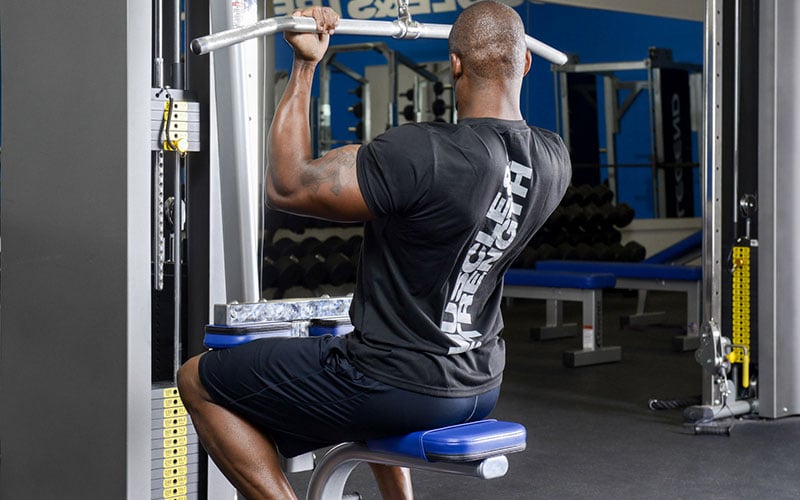
By extension, pulldowns can be aided by using the same method. And none of the above is to imply that an extreme lean forward and backward is OK. It still needs to be done in moderation. That means, a sharp movement that perhaps involves 12 inches of total torso change is a smart directive to apply, but more than that risks getting sloppy.
3. Push Presses
This isn’t a cheat since it’s a justified exercise in itself. But a smart tactic to tack on to the end of a set of strict presses would be to add push presses so you move past mechanical failure.
Adding a leg drive to a strict press makes the press stronger, but allows your fatigued shoulders to have to bear more load on the eccentric rep, to get the most out of the extra reps.
Summary
If you’re going to cheat, do it right.
This is the only “free pass” the weight room and gains are ever going to give you, so don’t abuse it. It’s your chance to forego “perfect form” in the name of more muscle, and you’ve got to do so safely.
And one more thing - If you’re not a lifter with a solid baseline of strength and development, then this isn’t for you.
You need to focus on the grass roots before employing methods like this. A house is only as strong as the foundation it’s built upon.
Put in the time.