Endomorph Bodybuilding: How To Optimize Your Diet & Workout For Results

It seems like every other article in the muscle building world is aimed at skinny ectomorphs. How to gain weight, how to eat more, how to become an ex-hardgainer.(I wrote that myself!)
But what about endomorphs? What about the guys who want to build muscle but already have a fair amount of fat? This article is meant to help the endomorph achieve the goal of building muscle while remaining relatively lean.
Before I dive in let it be known that I am aware that perfect ectomorphs, endomorphs and mesomorphs do not exist in nature. We are all combinations of these three somatotypes. With that said, many of you have strong endomorphic tendencies. That is why you are here.
So without further ado, let's get you shedding body fat and packing on muscle mass.
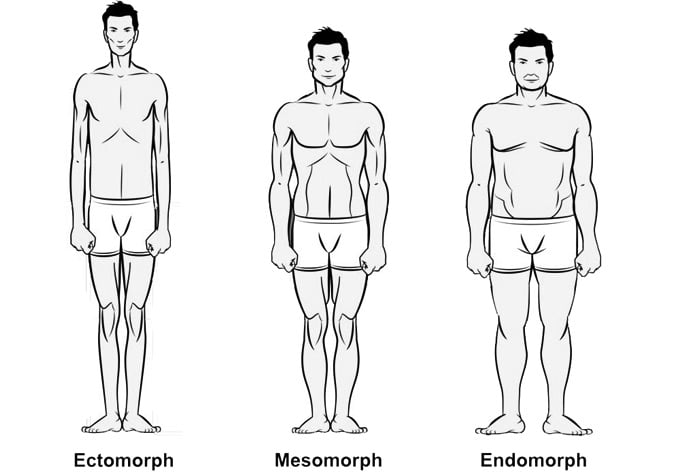
Image courtesy of Govt. of Western Aust. Dept. of Health
What is an Endomorph?
An endomorph is generally considered to be a lifter who can gain both muscle and fat rather easily. They are often called stocky, and it is not uncommon for an endomorph to be short (or shorter) and round.
When undertaking an aggressive bulk, an endomorph usually has an easy time adding strength, but pays the price with an unforgiving scale weight. They often grow frustrated, living with the constant mental battle...should I bulk, should I cut, should I bulk?
Assuming an endomorph has the following goals:
- Lose fat
- Build Muscle
...how then should they proceed? Should an endomorph remain in an endless cycle of bulking and cutting? To answer this question we need to know how much fat the lifter is currently carrying around.
If you feel you are carrying around too much body fat already, or are overweight, then it's best to start with a cut. Peel the extra fat off first, and then move on to a long, clean, smart bulking period.
The worst thing any endomorph can do is enter a lean bulking period obsessed about the amount of fat they currently have. I've seen more than my share of this over the years. The endomorph will never stop talking about their current body fat levels and it almost invariably causes a long term clean bulk to crash and fail.
On the other hand, if you are comfortable with your existing bodyfat levels and are ready to enter a 2-3 year clean bulk stage, skip the next section and move on to the bulking section below.
The Endomorph and Fat Loss - How to Cut
The good news is that you gain muscle and strength easily. This can only help you maintain muscle mass while cutting. The bad news is that you have to cut, or go through a fat loss period. That is rarely ever fun.
To maintain the maximum amount of muscle mass during a cut you want to lose about 1.5 to 2 pounds of fat per week. This is the number we are going to try and dial you into hitting.
Weight loss during the first 2 weeks of a cut is fairly meaningless. During this period you will lose excess water due to a reduction in your carbohydrate intake, a possible reduction to to reduced sodium intake, and a relaxing of your digestive system - or allowing yourself to get cleaned out.
Week 3 will be your baseline week. You want to lose no more than 2 pounds during this week. Use the following chart to make calorie adjustments based on week 3's weight loss.
- Lost 8+ pounds - Increase calorie intake by 500 calories and monitor weight loss for 2 weeks before making another adjustment.
- Lost 5-7 pounds - Increase calorie intake by 350 calories and monitor weight loss for 2 weeks before making another adjustment.
- Lost 3-4 pounds - Increase calorie intake by 200 calories and monitor weight loss for 2 weeks before making another adjustment.
- Lost 1.5 to 2 pounds - Perfect. Don't change anything.
- Lost 0 to 1 pound - Decrease calorie intake by 200 calories and monitor weight loss for 2 weeks before making another adjustment.
- Gained 1 to 3 pounds - Decrease calorie intake by 350 calories and monitor weight loss for 2 weeks before making another adjustment.
- Gained 4 pounds or more - Decrease calorie intake by 500 calories and monitor weight loss for 2 weeks before making another adjustment.
I can't state this enough - don't make adjustments based on weight loss during weeks one and two. Crazy things can and will happen. I can often lose 8 to 10 pounds in the first 3 to 4 days of a cut. This isn't fat loss, it's excess water due to eating a cleaner, lower carb diet.

How Much Fat Should You Lose?
Good question.
I do not advocate trying to get shredded. There is no point. You are about to embark on an extended period of muscle building. Spending an extra 8 to 12 weeks trying to get shredded will only be a waste of time.
Lose fat until you arrive at a normal, healthy body weight. When you look in the mirror (with clothes on) and feel satisfied and no longer feel obese, then it's time to build muscle.
This does not mean that you look in the mirror and see a ripped physique. It's hard to look ripped and impressive without a sufficient amount of muscle mass. Remember why this first step was taken - to shed a good portion of your existing body fat. Not all of it, but enough so that you feel human again and have no issues focusing on the muscle building process for several years.
Structuring a Fat Loss Diet
To run a successful cutting diet you have to base your plan off of your eating habits. If you are a big night time eater, then use intermittent fasting, or a similar variation. If you MUST have some ice cream before bed, then save a small percentage of your calories so that you can indulge.
A perfect diet is the one that helps you lose fat. At the end of the day it doesn't matter how you structure your eating, as long as it helps you reach your goals.
Here are some eating tips for men:
- If you are over 40, start with a baseline of 2,200 calories per day.
- If you are in your 20s or 30s and have an average metabolism, start your cutting diet with 2500 to 2600 calories per day.
- If you have an active job and a higher calorie maintenance level you may need to start your cutting diet with 3,000 calories per day.
It's better to start a cutting diet with a higher amount of daily calories, and pull them down as needed, then to start too low.
- Protein Intake - I recommend 200 grams of protein per day, or even a little more if you are eating over 2,500 calories per day and/or have a fair degree of natural muscle mass. An endomorph builds muscle easily, so is more likely to have a solid base of muscle tissue. You want to make sure you do not undereat protein while cutting fat.
- Fat Intake - Many of the endomorphs I know don't react well to higher carbohydrate eating plans. Obviously this is a generalization, and won't be true for everyone. With that said, I think you should make sure that 30% of your daily calories come from fats. If weight loss becomes stubborn, even while dropping calories, it may become necessary to eat more fats while reducing carbohydrate intake.
- Carb Intake - Now that you know how many calories, grams of protein, and amount of fats you are eating each day, you can determine your daily carbohydrate intake using the calories you have left. Simply divide your remaining calories by 4 to determine the number of carbohydrate grams you can eat.
The Endomorph and Cardio
It is imperative that endomorphs remain active outside of the weight room. This doesn't mean you have to live on a treadmill. It simply means you should be performing some consistent form of cardio.
If you decide to grind it out on a treadmill, opt for 3-4 sessions per week of about 20 to 30 minutes each. If you hate the treadmill, do something fun. Go hiking, go bowling, walk the dog, work in the garden. It really doesn't matter. Just make a point to stay active each day for at least 20 to 30 minutes.
You will want to maintain cardio, or this active lifestyle, while building muscle as well.
Endomorphs and Muscle Building
 It's time to build muscle. This will be a long term commitment. I recommend 2 to 4 years.
Do not embark on this journey with the word "cut" in your dictionary. You may need to make calorie intake adjustments over the coming years, but we will do everything possible to keep you relatively lean while building as much quality muscle mass as possible.
Understand that muscle building is a long term process. If you only look at changes over the course of 4 to 6 weeks, you are likely to get frustrated. Gaining a 1/4 inch on your legs in 6 weeks doesn't seem like much. If you add up those changes over the course of 3 years, then suddenly you've added 6 inches to your leg size. Impressive!
Before you begin the muscle building process get out a tape measure and document everything:
Take measurements every month. You will also want to weigh yourself every 2 weeks, and keep a log of these weigh-ins. Make sure you write all of this information down so there is no guessing. Real world data will help you make needed adjustments. Guessing is a fool's game.
Endomorphs and Lean Bulking
For an endomorph it is essential that weight gain be viewed over the long haul. Changes in scale weight must be slow, steady and precise. If weight gain is too rapid, it will be mostly fat gain. If weight gain is too slow, you will be stiffling the muscle building process.
You will gain some fat over the course of this bulk. "Some" does not mean you will "get fat." If you gain 20 pounds of muscle over the next 2-3 years, then gaining 5 to 15 pounds of fat will be meaningless. You will look amazing, and will only be a few months of fat loss away from being lean, mean and shredded.
Remember that body composition changes not only with fat gain, but also with muscle gain. You will gain minor amounts of fat over the course of this bulk, but the muscle you will be building will hide that fat gain well.
Muscle Building Expectations and Rate of Weight Gain
The topic of natural muscle building has been studied exhaustively. We know approximately how much muscle mass a natural trainee can expect to build year in and year out - in a perfect world.
Understand that the following guidelines are not presented as limitations. They should be used to help determine a proper rate of weight gain. You can choose to ignore these rates if you'd like, and gain weight more rapidly, but do so knowing that you are likely to add more fat than you'd like.
If you have yet to experience "beginner gains", then the following muscle building expectations are reasonable:
- Year 1 - 12 to 16 pounds of muscle
- Year 2 - 6 to 8 pounds of muscle
- Year 3 - 3 to 4 pounds of muscle
- Year 4 - 2 to 3 pounds of muscle
- Year 5 - 1 to 2 pounds of muscle
Think of natural muscle building as being like a glass of water. We each have limitations as to how much muscle we can build naturally. These limitations are physiological in nature. It doesn't matter what these limitations look like. That topic is for another article.
For the sake of discussion view the amount of muscle you can build as a tall glass of water. The more you drink from it now, the less you will have to drink from later. We tend to gain muscle rapidly right out of the gate, and see a constant decrease in this rate of building.

This topic isn't really debatable. Ask any natural bodybuilder and they will tell you that they rate of muscle building decreases noticeably year in and year out. After 5 years they are squeezing out ounces of gains each year, not pounds.
Again, the point in bringing this up isn't to discourage you, but rather to help you build an eating plan that will take this decreasing muscle building rate into consideration so you don't get fat. This article isn't about limitations, but rather assisting you to reach your goal of building muscle while minimizing fat gains.
So, assuming you haven't build any substantial amount of muscle mass, use the following weight gaining guidelines. They will help you minimize (not negate) fat gains while you build muscle:
- Year 1 - Gain 1.5 to 2 pounds per month
- Year 2 - Gain 1 pound per month
- Year 3 - Gain 0.5 to 0.75 pounds per month
- Year 4 - Gain 0.25 to 0.5 pounds per month
- Year 5 - Gain no more than a 0.25 pound per month
If you've already experienced beginner gains, say at least a 10 pound increase in muscle mass, then it's best to skip to year 2 and limit weight gain to one pound per month.
Building an Endomorph Eating Plan
Building a bulking plan really isn't all that different than building a cutting plan. You will start with a certain daily calorie target, and make adjustments based on what the scale is doing.
Here are some suggested daily calorie starting points:
- Over 40 - 2500 calories per day
- 30-39 years old - 2750 calories per day
- 25-29 years old - 3000 calories per day
- 20-24 years old - 3250 calories per day
Activity level will also play a role in how many calories you need per day. Understand that the above numbers are merely starting points. Adjustments will have to be made. Don't fear them. They are part of the process. It doesn't matter where you start because it won't take long to zero in your bulking diet.
Macronutrients can be adjusted as needed. Use the following guidelines to get started:
- Protein - 180 to 250 grams per day. The more calories you eat per day, the more protein you should eat. This will help balance your eating.
- Fats - 20 to 35% of your daily calories. If you find it harder to eat enough food, then a higher fat diet is the way to go. Fats contain 9 calories per gram, compared to 4 calories per gram for carbs and protein.
- Carbs - After allotting your daily proteins and fats, fill in the rest of your daily eating plan with healthy carb sources including fruits, veggies and quality grains.
We will ignore the weight gain over the course of the first 2 weeks of bulking. You will be eating more carbohydrates and generally more sodium. This will cause you to take in some extra water. This is NOT rapid fat gain, so do not panic.
Monitor your weight gain starting on week 3. See what is happening during the 4 week period from week 3 to week 6. Use the following chart to make calorie adjustments based on weight changes during weeks 3 through 6.
- Gained 8+ pounds - Decrease calorie intake by 500 calories and monitor weight gain for the next 4 weeks before making another adjustment.
- Gained 5-7 pounds - Decrease calorie intake by 350 calories and monitor weight gain for the next 4 weeks before making another adjustment.
- Gained 3-4 pounds - Decrease calorie intake by 200 calories and monitor weight gain for the next 4 weeks before making another adjustment.
- Gained 1-2 pounds - Stay the course and monitor weight gain for the next 4 weeks before making another adjustment.
- Gained 0 pounds - Increase calorie intake by 200 calories and monitor weight gain for the next 4 weeks before making another adjustment.
- Lost 1-2+ pounds - Increase calorie intake by 350 calories and monitor weight gain for the next 4 weeks before making another adjustment.
Cheat Meals and "Junk Food"
It's ok to save 10-20% of your weekly calories for what might be considered junk calories, or junk food. Eating clean 100% of the time isn't always possible, or reasonable.
I suggest allotting yourself a couple meals per week. By doing so you can attend a movie or family gathering and enjoy life without having to drag your "meal containers" with you. That gets old, and fast.
Endomorph Bodybuilding - How to Workout
You've probably heard someone say: diet is 90% of the muscle building process. I disagree. Here's why:
A perfect bulk without progressive overload is merely an intelligently designed fat gaining program.
Period. End of sentence.
Far too many bulks fail because a lifter is not focused on progressive overload. They might "work hard" in the gym, but working hard is not the same as working smart.
To build muscle you need to train a certain way. You don't just hit the gym to burn calories.
Progressive overload is the cornerstone of the muscle building process. It doesn't matter what style of training you are using; if you're not trying to challenge yourself using more resistance, your body will quickly adapt. When it adapts you are no longer encouraging it to build muscle. At that point your bulk becomes a fat building diet.
Now I know what some of you are thinking. Drop sets, supersets, rest-pause training is very taxing. Why can't you just focus on that, and not progressive overload? The answer is simple.
Let's look at drop sets. If you use a certain drop set pattern over the course of the next month, it will definitely be challenging. At some point though, you will need to add weight. If you do not, your body adapts and will no longer make gains.
My advice is to focus on maximizing every set. If you push every set for as many reps as possible, and add weight when you can, you will be maximizing progressive overload. This relentless pursuit of strength within hypertrophy ranges (muscle building rep ranges) will help you turn your bulk into a muscle building program.
Here are several popular workout programs from M&S that are perfect choices for long term clean bulks: