5 Potent Tips To Beef Up Your Biceps And Triceps

It's no secret that everyone wants massive arms. Head into any commercial gym and if the lifters aren't hammering out bench press or cable flye reps, they are knocking out set after set of arm work.
Unfortunately, while the desire and effort to build bigger arms is there, the execution is weak. Work is being done, but it is rarely efficient, focused or productive. Quite often, broscience has crept in and trainees attach to beliefs that really aren't beneficial. In many cases, these practices might even be counterproductive.
The tips in this article are meant to refine your training efforts and improve your results. They are some of the cornerstones of my arm building teachings; nuggets of information that I force feed to anyone seeking to build bigger biceps and triceps.
Tip #1 - Maximize the secret function of the triceps
Most everyone knows the triceps is an extensor muscle. It is used to extend resistance away from the body, working as an antagonist to the biceps. In an attempt to isolate this movement/function, trainees will fixate their elbows into place during skullcrushers (lying triceps extensions) and lock their elbows at their side while performing cable tricep extensions.
This is actually not the best way to perform these movements. Let me explain why.
One of the major, but virtually unknown functions of the tricep is to drive the elbow down or back towards the body. The long head of the triceps runs from the scapula to the elbow, and is a two joint muscle. Two joint muscles have two functions, a distal and a proximal function. In the case of the long head of the triceps, its functions are:
- Distal - Elbow extension. To extend the arm away from the body, working as an antagonist to the biceps.
- Proximal - Shoulder extension. To extend the elbow/arm towards the body, or back slightly past the torso (think driving a straight arm backwards, from your side).
To engage the proximal function of the triceps (the long head), do the following:
- Cable tricep extensions - Let the bar/rope come up higher, allowing the elbows to travel up away from your sides. By doing this, you will be engaging both the distal and proximal function of the triceps when extending the arm downwards.
- Skullcrushers - Let the EZ bar travel down towards the back of the head. This will allow you to engage the distal and proximal function of the triceps when extending the bar upwards.
Parting shot - Stop ignoring the long head of the triceps. Let that bar travel and start engaging all 3 heads.

Tip #2 - Upgrade the chin-up to priority status
The chin-up is an amazing arm building exercise, but it is completely ignored. Before we talk more about incorporating this movement, let's explain the difference between a chin-up and a pull-up.
- Pull-up - Performed with palms facing away from the body.
- Chin-up - Performed with palms facing towards the body, utilizing a closer grip.
Now, let's analyze the chin-up with a little more detail. It is a compound bodyweight movement that involves both the biceps and the back. In fact, it is one of the few (if only) bicep-centric compound exercises worthy of leading off your bicep training workout.
Is it better than barbell or dumbbell curls? Well that's debatable. It is surely equivalent, if not a better choice for some trainees. I would highly recommend adding it to your bicep training repertoire, performing chin-ups at least every other workout, if not every bicep workout.
Now here's another aspect of the chin-up you haven't considered. Not only is it a biceps builder, but the chin-up also calls into play the long head of the triceps. Yes, you read that right - the chin-up works both the biceps AND the triceps (to a lesser degree). Got your attention now? Good.
As mentioned in the first tip, the proximal function of the triceps involves driving the arm/elbow back towards the body. When performing the chin-up, you are are not only engaging an intense bicep contraction, but also calling into play the long head of the triceps as your elbow travels back towards your torso. This makes the chin-up a perfect exercise to be used on days when you work both the biceps and the triceps.
Parting shot - The chin-up is a rare bird; both a bicep-centric compound exercise, and it challenges the triceps. Its value should not be discounted.
Tip #3 - Tag team your triceps with an extension and a press
Most trainees include multiple extensions in their triceps training, but rarely add in a heavy-hitting press. While extensions have value, I highly recommend taxing your triceps with a press first. The triceps is a powerful muscle group. Slap some weight on the bar and challenge it.
Examples of these exercises include:
- Extensions - Cable tricep push downs, overhead dumbbell extensions and skullcrushers.
- Press - Close grip bench press, close grip incline bench press, close grip decline bench press, the Tate press and the seated French press.
One of the main objections about performing heavy close grip bench presses after chest or shoulder work is:
My triceps feel fatigued, and I don't feel like I am lifting enough on close grip benches afterwards.
So what? This is extremely poor logic and usually a cop out. If your triceps are fatigued, they aren't going to perform optimally regardless of the exercise(s) you choose. Taking this further: it doesn't matter if your triceps feel slightly taxed. Working them hard and doing what you can will create growth. Wimping out and not challenging them as hard as possible will only yield sub-par results.
Besides, bodybuilding isn't a battle of strength, it's a battle of progression. It doesn't matter what weight you move during your press exercise, as long as you are trying to progress.
Parting shot - Always, always, always include a triceps press exercise in the mix.
Tip #4 - Stop overtraining your biceps
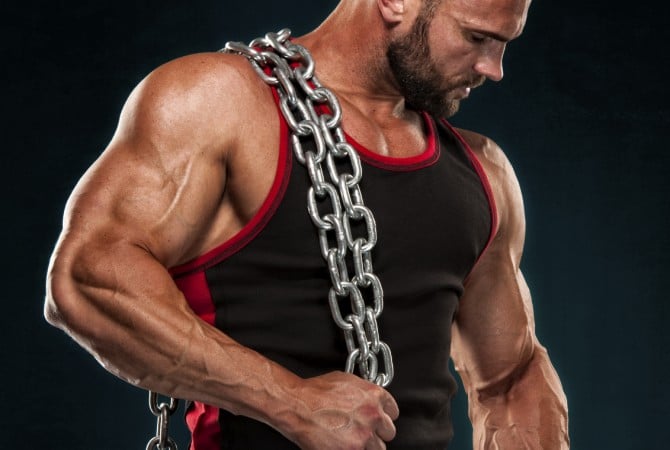
This is by far and away the biggest arm building mistake. Not only is the biceps a very small muscle group, not requiring much volume to grow, but overuse/overtraining also leads to tendonitis. If I had a dollar for every time a lifter complained of elbow tendonitis, I would have a lot of dollars.
Back in 1997 I developed extremely debilitating elbow tendonitis. For the 11 years prior, I hammered my biceps with 12 to 16 sets per arm training session. The pain was nearly unbearable. Want to know what cured my tendonitis? Dropping my direct bicep training to only 3-6 sets per week.
Now I am not telling you that you need to go this minimalist. What I am saying is that it's beneficial in the long run to restrict your biceps training to 6-9 sets per week, max. Believing you need more direct bicep stimulation than this is simply paranoia. Instead of focusing on volume (quantity), focus on progressive overload and maximizing each set (quality).
Another point to consider: the triceps make up 2/3rds of your arm size. If you want thick, impressive arms, you are far better off destroying your triceps. Not only do they have more size potential, but I have also found that my triceps handle a greater amount of training volume. This is a win/win.
While elbow tendonitis might not be on your radar screen right now, if you continue to overwork your biceps it will be soon enough. While the average "bro lifter" fears using squats and deadlifts because it might hurt their knees and back, the most likely injury threat they will face comes from overtraining the biceps. Stop crushing your biceps into dust using set after set after set after set.
Parting shot - Elbow tendonitis is a real threat. Take it seriously now, or pay the price later. Bigger biceps should be built with patience and overload before volume.
Tip #5 - Get your freak on with a 5 minute finisher
This is one of my favorite ways to finish off an arm training session. Here's how it works:
- Head over to your gym's cable system and load up a weight that would normally allow you to perform 15 reps per set.
- Now, perform cable tricep extensions or cable curls for 5 minutes.
Yes, you read that correctly. Set length is 5 minutes. You will need to take frequent, but short rests during this mega-set. Perform as many reps as you can, rest only briefly (until some of the pain rescinds), and start knocking out reps again.
If your gym has no cable system, use moderately light dumbbell curls and skullcrushers. I also like to use lightweight close grip bench presses as a finisher.
This tip might seem to contradict the previous tip, but it doesn't. Finishers should be used wisely. Obviously, you don't want to smash out 16 sets for biceps and then complete a 5 minute finisher. For biceps, I would prefer you perform only about 6 sets max, then a finisher. For triceps you can handle a little more volume (if you feel you need it) before trying this finishing approach.